Feeding a garage heater, from 1 lb cylinders to a big tank
The tank decides how long your heater runs, how it copes with the cold and how much fuss each session takes. This guide walks from the 1 lb cylinder to a large tank piped in by your propane supplier, with run times for each and the rules that keep the gas outside.
Three ways to feed a heater
Portable heaters run on disposable 1 lb cylinders or on a 20 lb tank connected by a hose. Fixed heaters, such as a wall heater or a unit heater, run on a gas line from a large tank outside.
The right choice depends on how big the heater is and how often you run it. A tank too small for its heater also fades on cold days, which matters more in a garage than in a heated room.
1 lb cylinders
A 1 lb cylinder holds about 22,100 BTU of propane. The Portable Buddy gets 2.4 hours on high and 5.4 hours on low from one, according to its listing, which is about one afternoon at the bench.
The Big Buddy takes one or two cylinders, giving 1.5 to 6 hours on one and 3 to 12 hours on two, per its manual. On a single cylinder it runs only on low or medium.
These are DOT-39 disposable cylinders, and PHMSA warns never to refill them. Its refill warning explains why, so skip the refill adapters sold beside them.
A 20 lb tank on a hose
A standard 20 lb grill tank holds about 432,000 BTU, around twenty times a 1 lb cylinder. For a Buddy heater it stays outside and upright, with a hose through the wall to the heater.
The Buddy manuals list the hoses to use. The 10 ft Buddy hose F273704 works without a filter, while the F273701 and F273702 hoses go with the F273699 fuel filter.
Never bring the 20 lb tank into the garage for a portable heater. The Buddy manuals forbid it, and a leak from a tank that size indoors leaves a lot of gas looking for a flame.
The 85,000 BTU forced-air heater needs a 20 lb tank as its minimum and comes with its own hose and regulator. Its manual puts the cylinder at least 7 ft from the heater, upright and never in the path of the exhaust.
Run time per tank
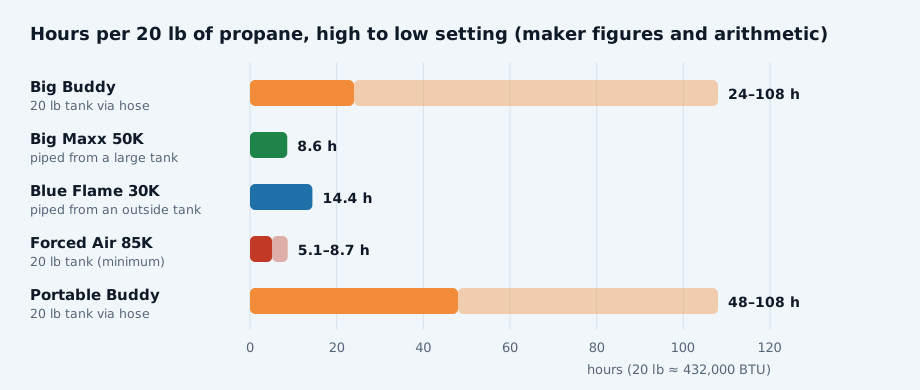
The chart shows the hours each heater gets from 20 lb of propane. The Big Buddy figures come from Mr. Heater, and the rest are arithmetic from about 432,000 BTU per tank.
| Heater | Rate | One 1 lb cylinder | One 20 lb tank |
|---|---|---|---|
| Portable Buddy | 4,000–9,000 BTU | 2.4–5.4 h (listing) | About 48–108 h (arithmetic) |
| Big Buddy | 4,000–18,000 BTU | 1.5–6 h (manual) | 24–108 h (manual) |
| Blue Flame 30,000 | 30,000 BTU | Not used | About 14 h (arithmetic), piped from a tank outside |
| Forced air 85,000 | 50,000–85,000 BTU | Not used | About 5–8.7 h at 2.3–3.9 lb/h (listing: up to 8.5 h) |
| Big Maxx MHU50 | 50,000 BTU | Not used | About 8.6 h (arithmetic); fed from a large tank |
Those hours assume a warm tank. Real tanks give less in the cold, and the Buddy manuals say run times drop below 20 °F.
A large tank piped in
A heater you run for hours every day outgrows grill tanks fast. By the same arithmetic a 100 lb cylinder holds about 2,160,000 BTU, roughly 72 hours at 30,000 BTU or 43 hours at 50,000 BTU.
The Blue Flame wall heater and the Big Maxx unit heater both need a fixed gas line from a tank outside. Your propane supplier can size a larger tank for the heater and the coldest weeks of your winter.
Fixed lines are a job for a licensed installer or the supplier, with a permit where one is required. The tank stays outdoors and upright on vapor withdrawal, and the Big Maxx also needs its propane conversion done during installation.
Cold weather and small tanks
Propane boils at about −44 °F, so it still turns to gas in a freezing garage. As a tank cools its pressure drops, and a heavy draw chills the liquid until the tank frosts and the flame sags.
Bigger tanks keep up better, which is why the Big Buddy manual recommends a 20 lb tank in the cold. Our guide to propane in a freezing garage explains the forced-air manual’s chart of what each tank size can sustain.
Connecting it safely
- Check the hose and regulator for cracks before each winter
- Tighten every connection and test it with soapy water, looking for bubbles
- Open the tank valve slowly, then light the heater per its manual
- Close the tank valve when you finish, as well as turning the heater off
- If you smell gas, close the tank valve, leave and air out the garage
Our nine safety rules cover the rest, from clearances to the CO alarm. A heater that sputters on a new hose or tank often has a supply problem, and our guide to a heater that won’t stay lit works through the fixes.
Matching tank to heater
- Portable Buddy at the bench now and then: 1 lb cylinders, or a 20 lb tank outside on a hose for longer sessions
- Big Buddy several times a week: a 20 lb tank outside on a hose, with the filter where the manual calls for one
- Forced-air warm-ups: a 20 lb tank as the minimum, kept 7 ft from the heater, and larger in deep cold
- Wall heater or unit heater: a large outdoor tank and a fixed line from a licensed installer
How big a heater you need comes first, and our BTU sizing guide works it out. On a budget, our look at a cheap garage heater under $150 weighs the small Buddy against the rest.
All five heaters sit in our garage heater picks, with run-time figures under how it works and the budget heater on the Portable Buddy card. Our Portable Buddy review covers its hose options too.
For spot heat on a small budget
The Portable Buddy runs on a 1 lb cylinder for an afternoon or on a 20 lb tank outside for days, gives 4,000 or 9,000 BTU and has an ODS and a tip-over switch. It warms you at the bench, not a whole two-car garage.