Why your heater’s propane tank fades in the cold
On the coldest morning your heater lights, roars for a while and then sags to a weak flame. The propane is still in the tank, but the cold is holding it back, and the fix is usually a bigger tank rather than a new heater.
Propane boils, and the cold slows it
A propane tank holds liquid, and your heater burns the vapor that boils off the top of it. Its boiling point is around −44 °F, which means it keeps vaporizing even when the garage is far below freezing.
Butane boils at about 31 °F and gives little gas near freezing. For a cold garage, propane is the right fuel, and every heater in this comparison is built for it.
The catch is pressure. The colder the liquid, the lower its vapor pressure, and the less gas the tank can push through the regulator to the burner.
Why the tank frosts on a long run
Boiling takes heat. As your heater draws vapor, the liquid pulls that heat from the steel shell and the air around it, so the tank cools below the garage temperature.
On a heavy draw the liquid chills faster than the air can warm it. Frost forms on the outside of the tank at the liquid line, the pressure drops and the flame shrinks, even though there is fuel left.
A bigger tank has more liquid and more steel in contact with the air, so it soaks up heat and keeps up better. That is why a 20 lb tank copes with deep cold far better than a 1 lb cylinder, beyond the extra fuel it holds.
What the manuals say about cold
- Big Buddy MH18B
- Run times drop below 20 °F, and Mr. Heater recommends a 20 lb tank in the cold; one 1 lb cylinder is for low and medium only
- Portable Buddy MH9BX
- Run times drop below 20 °F; runs on a single 1 lb cylinder or on a hose from a 20 lb tank outdoors
- Forced air MH85QFAV
- 20 lb tank minimum; its manual charts the heat each cylinder size can supply by temperature, and small tanks fall short in the cold
- Blue Flame 30,000 BTU
- Fixed gas line from an outdoor tank, installed per code
- Big Maxx MHU50
- Gas line from a large propane tank, after the installer fits the LP conversion
The pattern is plain. The bigger the heater, the bigger the tank it needs, and the colder the garage, the bigger again.
Small cylinders and big heaters
Each 1 lb cylinder carries roughly 22,100 BTU. On a cold bench it chills fast, and the Big Buddy manual allows a single cylinder only on its low and medium settings.
The 85,000 BTU forced air heater sits at the other end. Its manual puts its appetite at 2.3–3.9 lb of propane per hour, so a 20 lb tank is its minimum, and in deep cold even that can sag before it runs dry.
Never chase pressure by carrying a 20 lb tank indoors to sit beside a portable, and never refill a 1 lb DOT-39 cylinder. The Buddy manuals keep the big tank outside, and the guide to choosing a propane tank covers hoses and filters.
Hours per tank, warm and cold
A 20 lb tank holds about 432,000 BTU. Divide that by the heater’s hourly rate and you get a warm-weather run time, which the chart shows for each heater by maker figure or arithmetic.
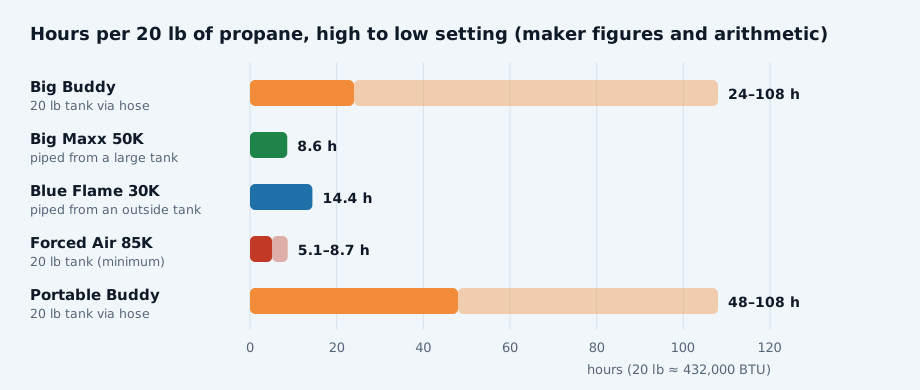
By that arithmetic, a Big Buddy on 18,000 BTU runs about 24 hours and the torpedo on 85,000 BTU about 5. In a freezing garage expect less, because the tank cannot always deliver the full rate and the heater runs longer to hold temperature.
An uninsulated garage needs noticeably more heat than an insulated one, often 1.5 times or more by a common rule of thumb. The guide to how many BTUs a garage needs works through the sums, and a bigger heater means a bigger tank.
Ways to keep the gas flowing
- Use a 20 lb tank rather than 1 lb cylinders for long cold sessions, kept outside for any portable
- Keep the tank upright so the heater draws vapor, never liquid
- Stand the tank on a dry base, off snow and ice, where air can reach its sides
- Keep a second full 20 lb tank stored outside, upright and away from heat, for long days
- Never warm a tank with a flame or aim a heater at it; the forced-air manual keeps the cylinder 7 ft away
- For all-day heat, ask your propane supplier about a larger tank and a fixed line, fitted by a pro
A cold tank never justifies moving it indoors or closing up the garage. Keep the big tank outside, keep the fresh-air openings open and keep a battery CO alarm in the garage while any unvented heater runs.
When a weak flame is not the tank
Low pressure is one reason a heater sags or dies, and it is the easiest to test. Swap to a full tank that has sat in milder air, and if the heater behaves, the cold was the cause.
If it still drops out, the low-oxygen pilot or a clogged hose may be to blame. For that, work through the seven fixes for a heater that won’t stay lit, in order.
Cold tanks and a wet garage
A cold garage turns damp when an unvented heater runs in it. Burn a pound of propane and roughly 1.6 lb of water vapor joins the air, then settles on the coldest surfaces, often your tools and the car.
The guide to wet floors and rust from a heater covers that side of winter. It explains why a vented heater keeps a garage dry where a portable leaves condensation behind.
A tank that never chills
A ceiling unit heater sidesteps small tanks altogether. The Big Maxx runs from a gas line fed by a large outdoor tank, with the LP conversion and the flue fitted by a qualified installer.
That is a bigger project in a higher price band, so it suits a garage you heat all winter. The Big Maxx or Big Buddy comparison weighs it against a portable on a 20 lb tank.
Our propane garage heater comparison sets out all five heaters. The sizing and run-time section and the comparison table put tank needs next to heat output.
If your garage stays below freezing
The Big Buddy runs from a 20 lb tank kept outside through a Buddy hose, the setup Mr. Heater recommends in the cold, for 24 to 108 hours per tank by its manual. It heats up to about 450 sq ft, so give it fresh air and a CO alarm.