Who makes the best garage heater, brand by brand
Every heater on our shortlist carries the Mr. Heater name, and that is no accident. This page explains why one brand fills the propane garage aisle on Amazon.com, which other makers compete in each type of heater, and when another name makes sense.
One name fills the propane aisle
We did not set out to pick five heaters from one maker. Mr. Heater, part of the Enerco Group, simply dominates propane garage heating on Amazon.com, from small radiant portables to a ceiling-hung unit heater.
That shows up in our guide to the best propane garage heater, where all five picks share the name. It also means parts, hoses and manuals are easy to find, which counts when a pilot acts up in January.
A brand does not make a garage safe, though. The type of heater, the fresh air and a CO alarm matter far more than the logo on the front.
What Mr. Heater makes, from portable to ceiling
- Big Maxx MHU50
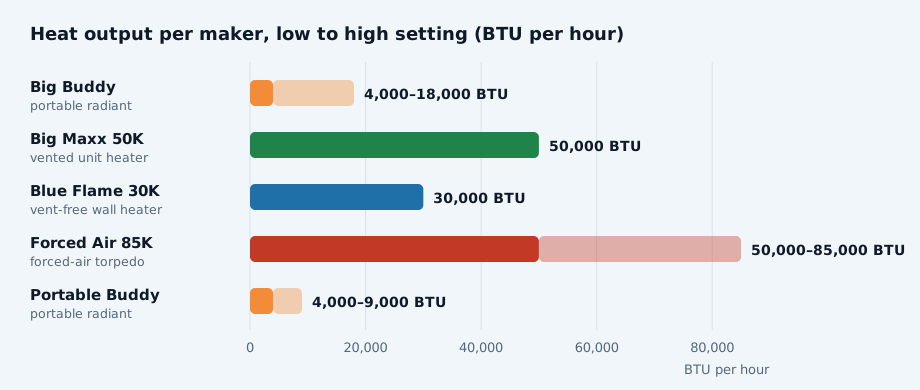
- Vented ceiling unit heater, 50,000 BTU input, up to 1,667 sq ft, wall thermostat; $$$
- Big Buddy MH18B
- Three-setting radiant portable up to 18,000 BTU/h for around 450 sq ft, with ODS and tip-over switch; $$
- Blue Flame 30,000 BTU
- Vent-free wall heater, dual fuel, built-in thermostat, ODS; $$
- Forced air MH85QFAV
- Torpedo, 50,000–85,000 BTU/h, 115 V fan, no thermostat; $$
- Portable Buddy MH9BX
- Two-setting radiant portable up to 9,000 BTU/h for around 225 sq ft; $
Each one represents a different way to heat a garage. The sections below set Mr. Heater against the other makers you meet in each category, so you can judge the type first and the brand second.
Unit heaters, where Reznor and Modine come in
A vented unit heater hangs from the ceiling, burns from a fixed gas line and sends its exhaust outside through a flue. It is the right shape for a garage you heat all winter, and it is our pick for a permanent install.
The Mr. Heater Big Maxx MHU50 leaves the factory configured for natural gas, and the propane parts come packed with it. The manual lists 50,000 BTU input, 40,000 BTU output and 80% efficiency, with 120 V for the blower and a 24 V or Wi-Fi wall thermostat.
Reznor and Modine are long-standing names in unit heaters, more often sold and fitted through heating contractors than ordered as a box. If a local installer stocks one of them, that support can matter more than the brand on the cabinet.
Our Big Maxx review covers the 10 ft ceiling it needs and the owner reports, from quick heat in two-car garages to some units that arrived damaged.
Vent-free wall heaters, Dyna-Glo and ProCom
A vent-free blue flame heater mounts on a wall, runs on a fixed gas line and warms the air by convection. It needs no flue, which is the appeal and the catch, since all its exhaust stays in the garage.
Mr. Heater’s 30,000 BTU dual-fuel model has a built-in thermostat, battery spark ignition and an ODS. The maker caps it at 4,500 ft of elevation and flags it as not for California, as our Blue Flame review explains.
Dyna-Glo and ProCom are the other names you meet most for vent-free wall heaters. Whichever you choose, check local codes first, since some states restrict unvented heaters indoors.
Torpedo heaters, GASLAND and BILT HARD
Forced-air torpedo heaters are the crowded end of the market. Mr. Heater’s 85,000 BTU model sits beside budget torpedoes from GASLAND and BILT HARD, all built around the same idea of a fan blowing across a propane flame.
The Mr. Heater manual calls its model “not for home or recreational vehicle use” and asks for 2 sq ft of fresh air low in the wall and the same again up high. Our forced air heater review explains why it suits short, attended warm-ups.
Whatever the brand, a torpedo puts all its carbon monoxide and water vapor into the garage. Compare the manual’s fresh-air and clearance rules, not just the BTU figure on the box.
Radiant and plaque heaters, ThermoMate
Small radiant heaters are where Mr. Heater’s Buddy line is strongest, with an ODS and a tip-over switch on both models in our five. ThermoMate sells vent-free plaque heaters that work on a similar radiant idea, mounted on a wall.
Radiant heat warms you and the bench in front of it rather than the air. That makes it fast to feel and slow to warm a whole cold garage, whichever brand is printed on the grille.
How the brands compare
| Brand | Heater types you meet | Where to buy | In our five |
|---|---|---|---|
| Mr. Heater (Enerco Group) | Unit heater, vent-free wall, torpedo, portable radiant | Amazon.com and stores | All five picks |
| Reznor | Unit heaters | Mostly through heating contractors | No |
| Modine | Unit heaters | Mostly through heating contractors | No |
| Dyna-Glo | Vent-free wall heaters | Amazon.com and stores | No |
| ProCom | Vent-free wall heaters | Amazon.com and stores | No |
| GASLAND, BILT HARD | Forced-air torpedoes | Amazon.com | No |
| ThermoMate | Vent-free plaque heaters | Amazon.com | No |
We list the rivals by category only. Their specs vary model by model, so read the listing and the manual before you buy, and see our top pick, the Big Buddy, for the reasoning behind the shortlist.
Which brand should you pick?
Decide the type before the brand. A garage you heat all winter wants a vented unit heater, while a weekend shop can live with a portable, and our Big Maxx or Big Buddy comparison weighs those two against each other.
Then pick a maker with parts and support near you. For a unit heater, that may be the brand your local installer fits; for portables and hoses, Mr. Heater’s reach is hard to beat.
Whichever logo you choose, the rules stay the same. Give an unvented heater fresh air, keep clearances, fit a battery CO alarm, and leave fixed gas lines to a licensed installer or the propane supplier.
No brand stops carbon monoxide from building in a closed garage. Every unvented heater, from any maker, burns your oxygen and leaves its exhaust in the room, and an oxygen sensor is a backup, not a reason to skip ventilation.
The Mr. Heater we would start with
For most garages we would start with the Mr. Heater Big Buddy, a portable rated for indoor use that needs no installer and carries an ODS and a tip-over switch. Give it its fresh-air openings and a CO alarm, and step up to the vented Big Maxx if you end up heating all winter.

