Carbon monoxide and the heater in your garage
Carbon monoxide has no smell or color, and the garage is where most homes keep the engines that make it. This guide shows where CO comes from with a propane heater running, why an oxygen sensor will not warn you, and which alarm and habits keep you safe.
Where carbon monoxide comes from
Propane that burns completely leaves carbon dioxide and water vapor. When the flame runs short of oxygen, gets dirty or is out of adjustment, part of the carbon leaves as carbon monoxide, a gas you cannot see or smell.
CO takes the place of oxygen in your blood. The CDC’s carbon monoxide page explains how it sickens and kills people in closed spaces, often before they notice anything wrong.
Why a garage is a special case
Garages hold the engines that make the most CO in any home. A car warming up, a generator, a snow blower or a mower can fill a closed garage far faster than any heater.
The CDC says never to run a generator, car or gasoline engine inside a garage, even with the door open. That rule holds with a heater running too, since the heater adds its own exhaust to the same air.
Where CO builds with a heater running
Unvented heaters in a closed garage
Every unvented heater, from the Portable Buddy to a vent-free wall unit, leaves all of its exhaust in the garage. In a closed space the oxygen falls and the exhaust builds, and a flame starved of air makes more CO.
That is why each manual sets fresh-air openings, one low and one high. The drawing shows the layout, with the big tank outside and the car and cans kept clear.
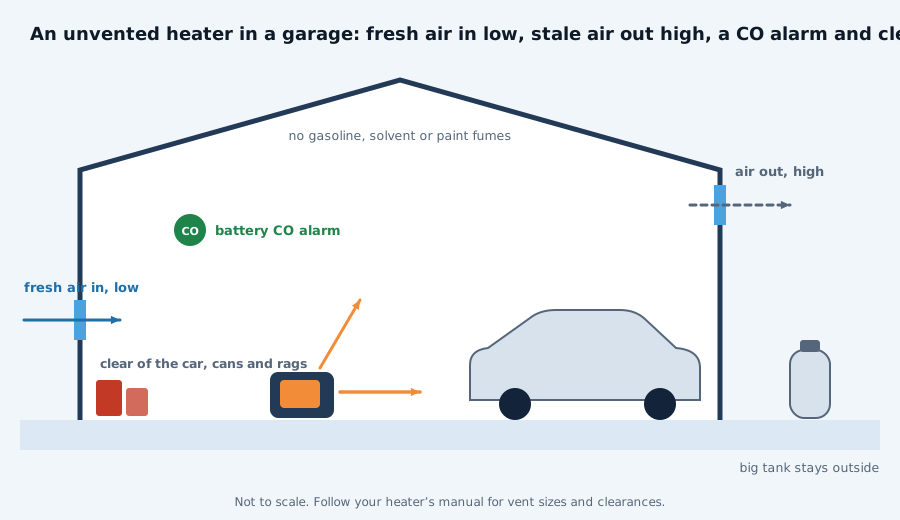
A forced-air heater in a small space
The 85,000 BTU torpedo makes the most exhaust of the five, burning up to 3.9 lb of propane an hour straight into the room. Its manual says it is not for home use and calls for 2 sq ft of opening near the floor and another 2 sq ft near the ceiling.
Treat it as a warm-up tool for a ventilated shop, run while you are there and never left on in a shut garage. Our 85,000 BTU forced air review covers its rules in full.
A dirty or damaged burner
Dust, spider webs and a clogged pilot change how a flame burns. A burner that looks different from its first season needs cleaning or service before you rely on it in a closed garage.
A blocked or leaking flue
A vented heater keeps CO out only while its flue works. A nest, ice or a joint that has slipped can push exhaust back into the garage, which is why the Big Maxx manual asks for a yearly inspection by a qualified service agency.
The door to the house
In an attached garage, CO can seep into the house through the connecting door. Keep that door closed while a heater or engine runs, and put an alarm on the house side as well.
An ODS is not a CO alarm
The Buddy heaters and the Blue Flame carry an oxygen depletion sensor, or ODS. It watches the pilot flame and shuts off the gas when oxygen drops, but it does not sense carbon monoxide at all.
CO from a car or a dirty burner can rise while oxygen is still fine, and the ODS will keep the heater lit. Treat the ODS as a backup and never as a reason to skip fresh air or the alarm.
A heater that keeps shutting off is often the ODS doing its job in stale air. Open the vents before anything else, and see our guide to a heater that won’t stay lit for the other causes.
The symptoms to know
CO poisoning feels like many ordinary complaints, from a cold to a long day under a car, which is why people miss it. The CDC lists these common signs.
- Headache
- Dizziness
- Weakness
- Upset stomach or vomiting
- Chest pain
- Confusion
If anyone in the garage feels them, turn the heater off, get everyone into fresh air and call 911. Stay out until the garage has aired out and you know the cause.
The alarm every heated garage needs
A battery CO alarm, or a plug-in model with battery backup, is the only device in the garage that measures the danger itself. The CDC recommends detectors that run on batteries or have a battery backup.
- Mount it in the garage where you work, not right beside the heater
- Put a second alarm inside the house by the connecting door
- Test it often and keep spare batteries on the shelf
- Check its operating temperature range, since many alarms are built for heated rooms
- Replace it by the date printed on it
Habits that keep CO down
- Open the fresh-air openings before you light any unvented heater
- Never warm up a car or run a generator in the garage
- Never sleep in a garage with an unvented heater running
- Run a torpedo heater only while you are in the garage, with large openings
- Keep burners clean and have a vented heater’s flue checked every year
Our ventilation guide sizes the openings for each heater, and our nine safety rules cover fire and fuel as well. If you are still choosing a type, our vented versus vent-free guide weighs the flue against the price.
Which heater lowers the risk
A vented unit heater removes the biggest CO source, its own exhaust. That makes the Big Maxx the safest propane garage heater to run all winter and our pick for a permanent install. Our top pick for most garages is still the portable Big Buddy.
It costs the most and needs a pro install, and it still needs a CO alarm for the car and the flue. The tips before you buy repeat the essentials for every heater.
No heater in a garage is safe without a battery CO alarm, and no ODS replaces one. Give every unvented heater its fresh air, and let the alarm watch for what the oxygen sensor cannot see.
For the garage you heat all winter
The Big Maxx MHU50 sends its exhaust out through a flue, runs on a wall thermostat and shuts off the gas with a flame sensor if the burner fails. It needs a qualified installer and a yearly flue check, and a CO alarm still belongs on the wall.