Mr. Heater 85,000 BTU forced air heater, fast heat with rules
The MH85QFAV torpedo heater warms a cold shop faster than anything else on our list. Its own manual also says it is not for home use, and that changes how you should use it in a garage. We did not run one, so this review reads the listing and manual against what owners report.
 Fast warm-up
Our verdict
The 85,000 BTU forced-air heater is the one to buy if you need a cold, ventilated work area warm fast before a job, and you will stay with it while it runs. Owners describe a shop at 50 °F in about 15 minutes. Its manual says it is not for home use, it blows all its exhaust and moisture into the room, it needs 2 sq ft fresh-air openings high and low, and no thermostat can be fitted. Treat it as a warm-up tool, never as the heater you leave running.
Strengths
- 50,000 to 85,000 BTU/h, variable, rated to 2,125 sq ft
- Warms a cold shop in minutes, per owners
- Hose and regulator included, auto spark ignition
- High-temperature limit shuts it down if it overheats
- Small and light for its output
Weaknesses
- Manual says not for home or RV use
- All exhaust, CO and water vapor go into the garage
- Needs 2 sq ft fresh-air openings near floor and ceiling
- No thermostat can be used, so it must be attended
- Needs a 115 V outlet and 6 ft of clearance from the outlet end
Buy it if
you need a cold, well-ventilated work area warm in minutes before a job, and you will stay with the heater until you switch it off.
Skip it if
you want a heater to leave running in a closed attached garage, or anywhere you might nap, store fuel or spray paint.
Specs: Mr. Heater 85,000 BTU Forced Air
| Type | Portable direct-fired forced-air (“torpedo”) heater |
|---|---|
| Heat output | 50,000 to 85,000 BTU/h, variable |
| Rated area | Up to 2,125 sq ft (listing) |
| Fuel use | 2.3 to 3.9 lb of propane per hour (manual) |
| Fuel | 20 lb tank minimum; hose and regulator included |
| Power | 115 V, 2 A, 230 W for the fan (manual) |
| Controls | Variable output; no thermostat can be used (manual) |
| Fresh air | 2 sq ft opening near the floor and 2 sq ft near the ceiling (manual) |
| Clearances | 6 ft from the outlet and top, 2 ft sides and rear; tank 7 ft away |
| Use | “Not for home or recreational vehicle use”; for ventilated work areas |
| Size and weight | 7.75 × 17.13 × 13.66 in, 14.18 lb (listing) |
| Warranty | 1-year limited |
Data from the Amazon.com listing and, where marked, from the maker’s manual. Price band $$: $150 to $300. Only the price Amazon shows at checkout counts.
85,000 BTU for a fast warm-up
The MH85QFAV runs between 50,000 and 85,000 BTU/h. The listing claims coverage of up to 2,125 sq ft. That is far more heat than any other heater here, in a body the listing puts at 14.18 lb.
In a garage it is a warm-up tool. One owner theme is a cold shop brought up to 50 °F in roughly a quarter of an hour, and that speed is the reason to own one, for a frozen Saturday morning before you start work.
It blows hot air out of the barrel, so heat reaches the far wall fast, then rises and fades soon after you switch off. Expect warm air rather than warm walls, tools and floor.
What “not for home use” means for your garage
The manual is blunt. It marks these heaters “NOT FOR HOME OR RECREATIONAL VEHICLE USE” and says they are meant mainly for temporary heat in buildings under construction, alteration or repair. The listing’s own usage field reads Outdoor.
An attached garage is part of a home, so we treat this heater as a warm-up for a ventilated work area that you stay beside, never something to leave running. Read the manual before it goes near your garage, and follow it over anything written here.
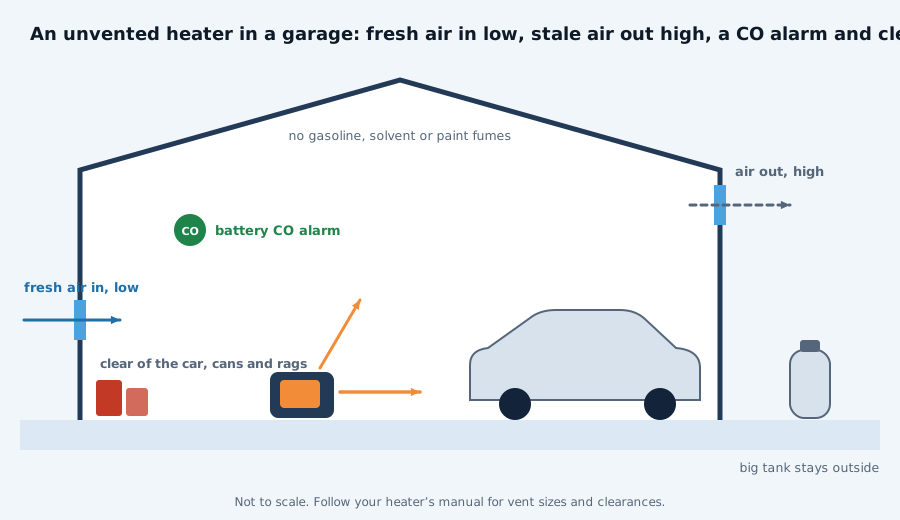
Indoors it may run only in a well-ventilated area. For the 85 and 125 models the manual sets a minimum of two openings, 2 sq ft low down by the floor and 2 sq ft high up by the ceiling, each about 17 × 17 in.
Carbon monoxide and moisture
A torpedo heater is direct-fired. Every bit of its exhaust, carbon monoxide and water vapor included, blows straight into the garage, and nothing on the heater senses CO or low oxygen.
At its top rate of 3.9 lb of propane an hour it puts roughly 6 lb of water into the air each hour, by our arithmetic. In a closed garage that fogs windows and leaves cold tools damp long after the heat has gone.
Hang a battery CO alarm before the first run, keep the house door shut, and get everyone outside if anyone feels a headache, dizziness or nausea. Our guide to carbon monoxide in a garage covers the signs, and the CDC’s prevention page repeats the rules.
Never run it while you sleep, never leave it unattended, and never use it with gasoline, solvent or paint thinner vapor in the air. A car or a generator running in the same garage is off the table too.
Clearances, tank and power
The clearances are large. The manual wants 6 ft from the outlet and above the heater, 10 ft from any tarp, and 2 ft behind and to each side, so a one-car garage with the car inside leaves little safe floor.
It needs a 20 lb tank as a minimum, connected with the included hose and regulator and kept upright for vapor withdrawal. Keep the cylinder at least 7 ft from the heater and never aim the hot outlet at it.
The fan needs mains power, 115 V at 2 A (230 W), through a grounded three-prong outlet. Auto spark ignition lights it, a high-temperature limit shuts it down if it overheats, and the manual forbids attaching duct work.
Controls and comfort
Output is variable between 50,000 and 85,000 BTU/h, but the manual says no thermostat can be used with it. You set the output, stay nearby and switch it off when the garage is warm enough to work in.
Without a thermostat, a garage swings from cold to too hot and back. The sensible pattern is to run it hard to take the chill off, then turn it down or off and let the warm air carry you into the first hour of work.
Mr. Heater calls the burner Quiet Burner Technology. Owners are mixed on the noise, and a fan pushing a big propane flame is never silent, so plan on raising your voice over it.
Run time and cold weather
The manual gives a burn rate between 2.3 and 3.9 lb per hour. By arithmetic a 20 lb tank lasts about 5 hours at 85,000 BTU/h and about 8.7 on the lowest setting, in line with the listing’s “up to 8.5 hours.”
Cold cuts that further. A chart in the manual matches cylinder size against temperature, and small cylinders fall short of full output once it turns cold, because heavy draw chills the liquid and drops its pressure. Our guide to why propane fades in the cold explains the curve.
For a heater this hungry, a 20 lb tank is the floor rather than the ideal. Keep a full spare outside, upright and away from the heater, and swap tanks with the burner off.
What owners report
Owners say it puts out plenty of heat, call it small and easy to use, and rate it good value for the money. The shop warmed to 50 °F in about 15 minutes is the theme that comes up most.
The listing has fewer owner reports than the Buddies, and noise splits opinion. Fresh air and CO rarely come up in owner comments, which is exactly why this review spends so long on them.
Against the Blue Flame, the Big Maxx and other torpedoes
The Blue Flame wall heater holds a temperature on its own thermostat and needs no power, at a fraction of the output. Our torpedo or Blue Flame page compares the two for a shop that has to warm up fast.
If the garage needs heat every day of the winter, the Big Maxx unit heater sends its exhaust outside through a flue. For gentle spot heat at a bench, the Big Buddy is quieter, cheaper to run and needs smaller vent openings.
GASLAND and BILT HARD sell torpedoes too, some with even more output, so read their manuals for fresh-air and clearance rules too. See the torpedo’s homepage card or our propane garage heater shortlist for all five side by side, and our fresh-air guide before the first run.
For a cold shop and a short warm-up
If you need a cold, ventilated work area warm in minutes before a job, and you will stay with it, this torpedo does that well. Open both vents, keep 6 ft clear in front, hang a CO alarm and switch it off before you walk away.


