How many BTUs your garage heater needs
Heater boxes promise “heats up to 1,000 sq ft” and similar, yet the volume of your garage, its insulation and the warmth you want decide the BTUs you need. This guide gives you a rule of thumb, worked examples for common garage sizes and the catch with oversizing an unvented heater.
What a BTU rating tells you
A BTU (British thermal unit) is the heat needed to warm one pound of water by one degree Fahrenheit. Heater ratings are BTU per hour, the rate a heater turns propane into heat on its top setting.
Propane holds about 21,600 BTU per pound, so an 18,000 BTU heater burns a little under a pound an hour on high. Most portables also have lower settings, and those decide how long a tank lasts once the garage is warm.
The Big Maxx manual gives two figures, 50,000 BTU in and 40,000 BTU out at 80% efficiency, because its flue carries some heat outside with the exhaust. An unvented heater keeps nearly all of its heat in the garage, along with all of its exhaust.
Start with the volume of your garage
Heat fills a space, so work in cubic feet rather than floor area. Multiply length by width by ceiling height, and a typical two-car garage of 24 × 24 ft with a 9 ft ceiling comes to 5,184 cu ft.
Typical floor areas run about 240–300 sq ft for a one-car garage and 400–600 sq ft for a two-car. A three-car garage usually covers 600–900 sq ft, though these are common sizes, not codes, so measure your own.
A rule of thumb for BTUs
A common rough rule multiplies cubic feet by the temperature rise you want in °F, then by 0.133, for an insulated space. It is a rule of thumb rather than an engineering calculation, but it puts you in the right range.
The temperature rise is the gap between the cold garage and the warmth you want. Taking a garage from 25 °F to 65 °F is a 40 °F rise, a fair target for working at the bench in a jacket.
For the 5,184 cu ft two-car garage, 5,184 × 40 × 0.133 comes to about 27,600 BTU per hour if the walls and ceiling are insulated. An uninsulated garage often needs 1.5 times that or more, about 41,400 BTU per hour.
| Garage | Example size | Volume | 40 °F rise, insulated | Uninsulated (× 1.5) |
|---|---|---|---|---|
| One-car | 12 × 22 ft, 9 ft ceiling | 2,376 cu ft | About 12,600 BTU/h | About 19,000 BTU/h |
| Two-car | 24 × 24 ft, 9 ft ceiling | 5,184 cu ft | About 27,600 BTU/h | About 41,400 BTU/h |
| Three-car | 32 × 24 ft, 10 ft ceiling | 7,680 cu ft | About 40,900 BTU/h | About 61,300 BTU/h |
Every figure in the table is arithmetic from the rule above. Wind, a drafty overhead door or a garage that drops to 0 °F all push you toward the top of the range.
What pushes the number up
- Insulation: bare stud walls and an open roof lose heat far faster than insulated ones
- The overhead door: an uninsulated door with worn seals is the biggest cold spot in most garages
- Ceiling height: a 12 ft ceiling or a lift bay adds volume, and warm air pools up there
- Your climate: a 60 °F rise in a northern winter needs half again as much heat as a 40 °F rise
- Fresh-air openings: an unvented heater needs vents to the outside, and they let some heat out
Weatherstripping the overhead door and insulating the ceiling often do more than a bigger heater. They also cut the propane every winter takes.
The five heaters by rated output
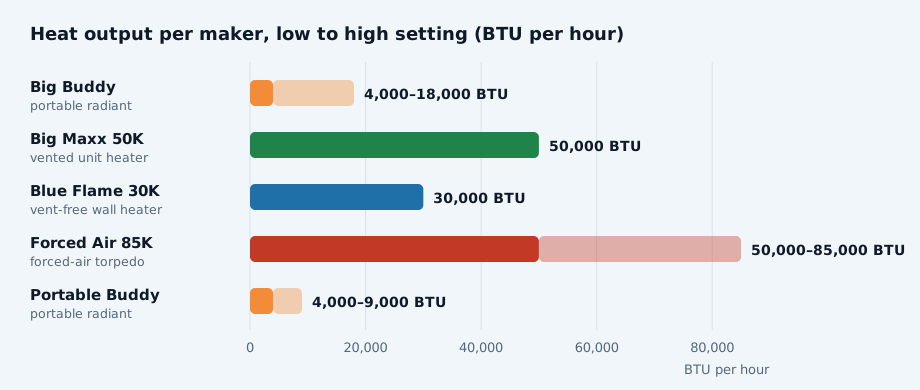
The chart shows each heater’s output from the listings and manuals. The table adds the area each maker claims, which assumes mild weather and insulation, so read those figures as the top of the range.
| Heater | Type | Rated output | Maker’s area | Garage it suits |
|---|---|---|---|---|
| Big Maxx MHU50 | Vented unit heater | 50,000 BTU in, 40,000 out (manual) | Up to 1,667 sq ft | Two- or three-car garage heated all winter |
| Big Buddy MH18B | Portable radiant | 4,000–18,000 BTU | About 450 sq ft | One-car garage, or spot heat in a two-car |
| Blue Flame 30,000 | Vent-free wall heater | 30,000 BTU | Up to 1,000 sq ft | Insulated two-car garage with fresh air |
| Forced air MH85QFAV | Torpedo | 50,000–85,000 BTU | Up to 2,125 sq ft | Fast warm-up of a ventilated shop |
| Portable Buddy MH9BX | Portable radiant | 4,000–9,000 BTU | About 225 sq ft | You at the bench in a one-car garage |
Set those against the sizing table. The Big Maxx delivers about 40,000 BTU per hour, close to what an uninsulated two-car garage or an insulated three-car needs, and it sends its exhaust outside.
Radiant heat plays by different rules
The Buddy heaters are radiant. They warm you, the bench and the floor in front of them, much like sunshine, and you feel that within minutes even while the air stays cool.
That makes the Big Buddy useful in a garage bigger than its 450 sq ft rating, as long as you work facing it. It will not bring a cold two-car garage up to shirt-sleeve warmth.
The 9,000 BTU Portable Buddy is spot heat for one person in a one-car garage. Treat both as personal heaters, and size a separate heater if you want the whole space warm.
Why bigger is not always better
An unvented heater puts all of its exhaust into the garage. Each pound of propane it burns leaves about 1.6 lb of water vapor in the air along with carbon dioxide, so a heater twice the size you need doubles both while it runs.
Vent-free heaters also need room. The National Fuel Gas Code calls a space confined when it has under 50 cu ft per 1,000 BTU/h, so a 30,000 BTU vent-free heater needs at least 1,500 cu ft unless extra outdoor air comes in.
Every unvented heater needs the fresh-air openings sized in its manual, and our guide to fresh air for a garage heater works them out. Whether a flue earns its extra install is the subject of our vented or vent-free guide.
Size against your fuel supply too
A bigger heater empties a tank faster. A 20 lb tank holds about 432,000 BTU, so simple arithmetic gives roughly 24 hours at 18,000 BTU but only around 5 hours at 85,000 BTU, and less in the cold.
The Blue Flame and the Big Maxx run all day on a fixed line from a large tank. Our propane tank guide matches tank to heater, and our page on propane in a freezing garage explains why small tanks fade on cold days.
Picking a size for your garage
- One-car garage, you at the bench: the 9,000 BTU Portable Buddy or the 18,000 BTU Big Buddy
- Insulated two-car garage, heated often: about 30,000 BTU, from a vent-free wall heater with fresh air or a vented unit heater
- Uninsulated two-car or any three-car garage, heated all winter: a 50,000 BTU vented unit heater such as the Big Maxx
- Cold shop that needs heat fast for a few hours: an 85,000 BTU forced-air heater with large fresh-air openings, attended
All five sit side by side in our guide to the best propane garage heater, with sizing notes under how it works and every spec in the comparison table.
For a two-car garage you heat all winter
The Big Maxx MHU50 puts about 40,000 BTU per hour into the garage and sends its exhaust and water vapor out through a flue. It sits in the $$$ band and needs a qualified installer, a gas line from a large tank and a 10 ft ceiling.