Mr. Heater Blue Flame, a vent-free wall heater
The 30,000 BTU Blue Flame gives you a wall heater with a thermostat and no flue, no wiring and no fan. That convenience comes with fresh air you must supply and moisture you must manage. We did not hang one ourselves, so this review weighs the listing and Mr. Heater’s rules against what owners report.
 Wall heater pick
Our verdict
The Blue Flame is the wall heater to buy if you want thermostat heat in the garage without a flue or an electrician. At 30,000 BTU it can keep an insulated two-car garage comfortable, and it runs through a power cut. It is vent-free, so it needs outside ventilation air, puts its moisture and exhaust into the garage and is barred or restricted in some places, California included. You also need a fixed gas line, fitted by a pro.
Strengths
- Built-in thermostat that owners describe as consistent
- 30,000 BTU/h, rated to 1,000 sq ft
- No electricity needed, battery spark ignition
- Dual fuel, propane or natural gas
- Low-oxygen shut-off (ODS) and wall-mount hardware included
Weaknesses
- Vent-free, so moisture and exhaust stay in the garage
- Needs outside ventilation air and a CO alarm
- Needs a fixed gas line from an outdoor tank
- Maximum elevation 4,500 ft, not for California
- Only a 1-year limited warranty
Buy it if
you want a fixed heater on a thermostat, have no room or budget for a flue, and your state, code and altitude allow a vent-free heater.
Skip it if
you live in California or above 4,500 ft, your garage is small and tight, or rust on your tools is already a problem.
Specs: Mr. Heater 30,000 BTU Blue Flame
| Type | Vent-free blue flame convection heater, wall mount |
|---|---|
| Heat output | 30,000 BTU/h |
| Rated area | Up to 1,000 sq ft (listing) |
| Fuel | Dual fuel: propane or natural gas, fixed gas line |
| Power | None; battery spark ignition (battery included) |
| Controls | Built-in adjustable thermostat |
| Safety | Low-oxygen shut-off (ODS) |
| Elevation | Up to 4,500 ft (maker) |
| Extras | Optional blower kit F299201, sold separately |
| Size and weight | 11.42 × 27.36 × 25.51 in, 26.1 lb |
| Restrictions | Not for California; check local codes for vent-free heaters |
| Warranty | 1-year limited |
Data from the Amazon.com listing and, where marked, from the maker’s manual. Price band $$: $150 to $300. Only the price Amazon shows at checkout counts.
30,000 BTU and a 1,000 sq ft rating
Mr. Heater rates this dual-fuel Blue Flame at 30,000 BTU/h and says it heats up to 1,000 sq ft. Read the area as a best case for a mild day in an insulated room, since a garage door leaks far more heat than a house wall.
The rough sizing sum (cubic feet × temperature rise × 0.133) gives about 27,600 BTU/h to lift a 24 by 24 ft, 9 ft high, insulated garage by 40 °F. The Blue Flame covers that, while a bare garage at roughly 1.5 times the load would keep it working flat out.
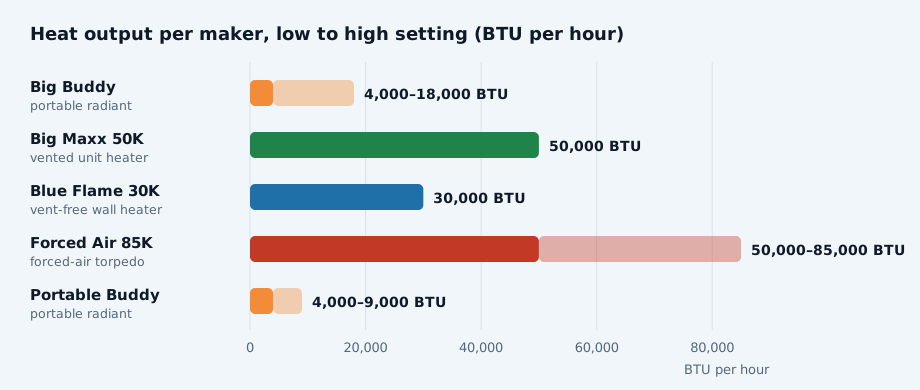
This is a convection heater, warming the air that rises through it, so the garage heats evenly but slowly from cold while warm air pools under the ceiling. Mr. Heater sells an optional blower kit, the F299201, to push that air back down.
The blower kit needs an outlet, which takes away part of the no-power appeal. Without it, a ceiling fan on low does much the same job, and you feel the difference most at floor level, where your feet and the car sit.
A thermostat and no electricity
The built-in thermostat is the main reason to pick it over a Buddy. You set a temperature and it holds there, and owners describe the thermostat as consistent from one day to the next.
It needs no power. A battery spark igniter, battery included, lights the burner, so it keeps heating through a power cut, which neither the Big Maxx nor the forced-air heater can do.
A thermostat also changes how you use the garage. Instead of lighting a portable each time you walk in, you leave the wall heater holding a modest setting, and the garage is never as cold as the driveway when you open the door.
That convenience has a cost in fuel and moisture. A heater that cycles all day burns propane all day, and every hour it runs adds water to the garage air, so set it no higher than you need to work in comfort.
Installing a vent-free wall heater
It hangs on the wall with the included hardware and measures 11.42 × 27.36 × 25.51 in at 26.1 lb. Mount it where cars, bikes and fuel cans stay well clear, and follow the manual’s clearances to the floor and ceiling.
It needs a fixed gas supply. On propane that means a tank outside and a line through the wall, fitted to code by a licensed pro or your propane company, with a permit if required. Owners find the heater itself simple to hang, but the gas line is the part to hand over.
Codes come first. Indoor use of unvented propane heaters is restricted in Massachusetts and in Canada, it is not for California, and above 4,500 ft the pilot and ODS may shut it down.
Ventilation, moisture and carbon monoxide
“No outdoor venting required” on the listing means no flue, not no fresh air. Mr. Heater says it needs outside ventilation air, and the ODS shuts the heater down when there is not enough.
The National Fuel Gas Code calls a space with under 50 cu ft per 1,000 BTU/h confined. For a 30,000 BTU heater that means at least 1,500 cu ft of garage, unless outdoor air is brought in through dedicated openings.
A 12 × 22 ft one-car garage with an 8 ft ceiling holds about 2,100 cu ft, which clears that bar with little to spare. Fill it with a car, shelving and boxes and the open air volume shrinks, so a small garage leans hard on its fresh-air openings.
All the exhaust stays inside. By our arithmetic it goes through roughly 1.4 lb of propane hourly at full output and leaves around 2.2 lb of water behind, which shows up as fogged windows and rust on cold steel.
Our guide to fresh-air openings sizes the vents in square inches, and our condensation guide deals with the damp. The trade against a flued heater is laid out in vented or vent-free.
The ODS reacts to low oxygen, not to carbon monoxide. Hang a battery CO alarm, keep the door to the house closed in an attached garage, and never run it near gasoline, solvent or paint fumes.
Fuel use and cold weather
At 30,000 BTU/h a 20 lb tank lasts about 14 hours by arithmetic, roughly three hours per gallon at full output. The thermostat cycles it, but a garage heated all winter still wants a 100 lb tank or larger outside.
Propane keeps vaporizing far below freezing, since it boils near −44 °F, but a small tank loses pressure as it chills. A larger tank keeps the burner steady through a cold snap, while the heater itself, indoors on the wall, does not mind the weather.
What owners report
Owners say it performs well, and one describes heating an 1,100 sq ft cabin in about 20 minutes. They call it easy to install and good value, and they like how steadily the thermostat holds a setting.
This dual-fuel version has fewer owner reports than the Buddies, and the listing gives a 1-year limited warranty. The summary shows few complaints, but the moisture and code questions above are the ones buyers do not always see coming.
Dual fuel is a quiet advantage. If you later run natural gas to the house, the same heater can switch over, so the purchase is not stranded when the propane tank goes.
Against the Big Maxx, the Big Buddy and the torpedo
The Big Maxx unit heater sends its exhaust and water outside through a flue, at a higher price and with a pro install. Our vented or vent-free wall heater page weighs that gap for a garage you heat every day.
The Big Buddy costs less, needs no gas line and moves with you, but has no thermostat. Blue Flame or Big Buddy sets fixed against portable for your garage.
The 85,000 BTU forced-air heater warms a shop much faster for short sessions, as torpedo or wall heater shows. ProCom and Dyna-Glo sell similar vent-free heaters, and the Blue Flame’s homepage card sits beside all five in our best propane garage heaters compared.
A wall heater for a garage with good air
If you want thermostat heat without a flue or an electrician, and your state, code and altitude allow a vent-free heater, the Blue Flame is the one we would hang. Give it outside air, a CO alarm and a gas line fitted by a pro.


