Big Maxx or Big Buddy heater for your garage
These are our top pick, the Big Buddy, and our pick for a permanent install, the Big Maxx, and they could hardly be more different. One sits on the floor and runs on a cylinder, the other hangs from the ceiling on a gas line and a flue, and the right one depends on how often you heat the garage.
Big Buddy for most garages, Big Maxx for heat all winter long
For most garages the Big Buddy is the sensible first buy, whether you rent, heat the garage now and then, or want heat this weekend without a contractor. If you own the house and work in the garage most winter days, the Big Maxx is the upgrade worth installing.
They are our top pick and our permanent heater in our best propane garage heater comparison. The Big Maxx is vented, so its exhaust leaves through a flue, while the Big Buddy is an indoor-certified portable that leaves its exhaust in the garage.
The Big Maxx sits in the $$$ band and the Big Buddy in the $$ band, before you count the Big Maxx’s install. The rounds below show where each one earns its place.
The two heaters, spec by spec
| Big Maxx MHU50 | Big Buddy MH18B | |
|---|---|---|
| Type | Vented ceiling unit heater, fan-forced | Portable radiant, indoor-certified |
| Heat output | 50,000 BTU/h input, 40,000 output, 80% efficiency (manual) | 4,000, 9,000 or 18,000 BTU/h |
| Rated area | Up to 1,667 sq ft, about a 3-car garage | Up to about 450 sq ft |
| Fuel and tank | Ships for natural gas; LP kit included; fixed line from a large tank | One or two 1 lb cylinders, or a 20 lb tank outside via hose |
| Run time | About 8.6 h per 20 lb at full fire (arithmetic), so it needs a big tank | 24–108 h on a 20 lb tank (manual) |
| Power needed | 120 V, 2.3 A | None |
| Thermostat | 24 V or Wi-Fi wall thermostat, sold separately | None, three manual settings |
| Venting and fresh air | Flue, 4 in vent connector, vertical or sidewall | No flue; 18 sq in openings at ceiling and floor |
| Safety devices | High-temperature shut-off, flame-sensor gas shut-off | ODS, tip-over switch |
| Install | Qualified installer or gas supplier; 10 ft ceiling minimum | None; set it on the floor |
| Weight | 60.3 lb | 13.01 lb (listing); 17.1 lb (Mr. Heater) |
| Price band | $$$ | $$ |
| Warranty | Check the listing | 3-year limited (listing) |
Heat and garage size
The Big Maxx puts about 40,000 BTU/h into the air, by the manual’s 80% efficiency. The listing rates it for up to 1,667 sq ft, and owners report it performing well and heating fast in two-car garages.
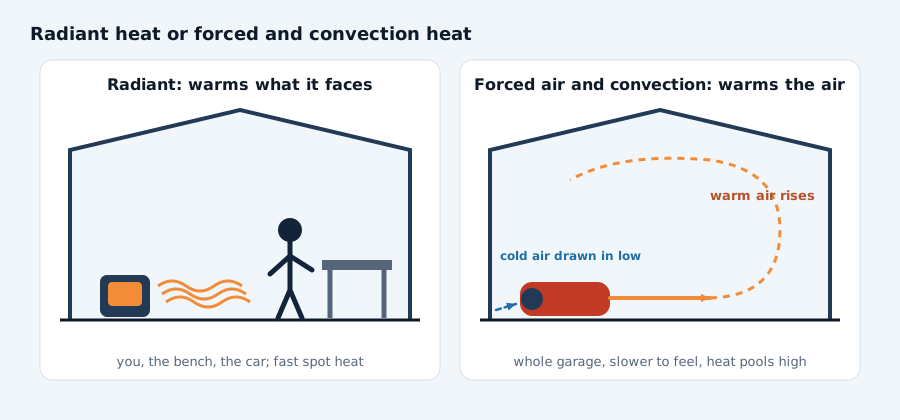
The Big Buddy tops out at 18,000 BTU/h of radiant heat, rated for about 450 sq ft. It warms you and the bench it faces, and owners describe a room rising about 20 °F in half an hour.
A typical two-car garage runs 400 to 600 sq ft. The Big Buddy covers the small end of that, while the Big Maxx has room to spare in an insulated one and comes close to what an uninsulated one needs.
Round goes to the Big Maxx.
Fuel and running
At full fire the Big Maxx burns about 50,000 BTU of propane an hour, near 8.6 hours from a 20 lb tank by our arithmetic. That is why it is piped from a large tank outside, filled by your propane supplier.
The Big Buddy sips by comparison. The manual gives 1.5 to 6 hours on one 1 lb cylinder and 24 to 108 hours on a 20 lb tank, which stays outside and feeds it through a Buddy hose.
Below 20 °F, the manual warns run times drop, and recommends a 20 lb tank in the cold. The pressure drop behind that is covered in our guide to propane in a freezing garage.
Round goes to the Big Buddy, for simple fuel.
Install and setup
The Big Buddy needs no install. You set it on the floor, connect a cylinder or a hose and light it with the piezo button.
The Big Maxx is a project. It needs a 10 ft ceiling, the heater base 8 ft above the floor, a gas line, the LP conversion, a 120 V circuit and a flue through the roof or a sidewall, all by a qualified installer or the gas supplier.
Owners comfortable with gas, wiring and vent work call the mounting straightforward. Our guide to installing a propane unit heater lists each step, and local codes or permits may apply.
Round goes to the Big Buddy.
Air quality and safety
This round decides the matchup for most people. The Big Maxx sends its carbon monoxide and water vapor out through the flue, and its manual wants the heater and vent inspected every year.
The Big Buddy leaves everything in the garage. On high it burns about 0.83 lb of propane an hour, which makes roughly 1.3 lb of water vapor an hour, our arithmetic, along with carbon dioxide and possibly CO.
Its ODS and tip-over switch are good backups, but the ODS senses oxygen, not CO. You still need the vent openings, a battery CO alarm and no fumes from gasoline or solvents around it.
Round goes to the Big Maxx, clearly.
Comfort and controls
A wall thermostat lets the Big Maxx hold a set temperature, so the garage is warm when you walk in. Owners split on noise, with some calling it quiet and others noisy.
The Big Buddy has three manual settings and no thermostat. The current “NF” model has no fan, so there is no fan noise, though some owners say it goes out after a few minutes from pilot or ODS trouble.
Round goes to the Big Maxx.
Price and value
The Big Buddy costs a fraction of the Big Maxx and takes nothing more than a hose to grow into. Owners call it good value, and it moves with you if you sell the house.
The Big Maxx adds an installer, a gas line and a large tank to its $$$ band. That money buys a garage that stays warm and dry, and our guide to garage heater brands shows where Reznor and Modine fit if you want a contractor’s unit.
Round goes to the Big Buddy, for occasional use.
Which one should you buy?
Start with the Big Buddy if you rent, heat the garage a few times a month, or want heat without a contractor, which covers most garages. The Big Buddy review covers its hoses and its pilot quirks.
Step up to the Big Maxx if you own the house, heat the garage most days and can fit a gas line and a flue. The Big Maxx review covers its clearances and owner reports in depth.
The Big Maxx is not a weekend project. The manual puts installation, the fuel conversion and service with a qualified installer, a service agency or the gas supplier, and gasoline or solvent vapor near it is off limits.
The Big Buddy is never a heater to sleep beside. Give it its 18 sq in openings and fit a battery CO alarm.
Which heater fits your garage
For most garages, buy the Big Buddy first for warm hands this weekend with no installer, provided the garage gets its fresh-air openings and a CO alarm. Heating through the whole winter? The Big Maxx is the upgrade, vented, on a thermostat and sized for two cars.

