A cheap garage heater under $150, and what it gives up
Only one heater in our lineup sits in the under-$150 band, and it is a good one for the right job. This page shows what that low price leaves out, how far 9,000 BTU stretches in a garage, and when stepping up a band saves you money over a winter.
What “cheap” buys in a propane garage heater
We never print prices, only bands. Under $150 is the $ band and $150 to $300 is $$, while anything over $300 counts as $$$.
Just one of the five heaters in our propane garage heater comparison lands in the $ band, the Mr. Heater Portable Buddy. Three sit in the $$ band, and the ceiling-hung Big Maxx is the only one above $300.
A cheap heater burns propane the same way a costly one does. The savings come out of heat output, run time per cylinder and the warranty, and a few of those you only notice on a cold Saturday.
The one heater in the $ band
The Mr. Heater Portable Buddy is a 9,000 BTU radiant heater with two settings, 4,000 and 9,000 BTU/h. The listing rates it for about 225 sq ft and certifies it for indoor and outdoor use.
- Heat output
- 4,000 or 9,000 BTU/h, radiant
- Rated area
- Up to about 225 sq ft (listing)
- Fuel
- One 1 lb cylinder, or a 20 lb tank kept outside via a Buddy hose
- Run time
- 5.4 h on low, 2.4 h on high per 1 lb cylinder (listing)
- Safety
- Low-oxygen shut-off (ODS), tip-over switch, piezo ignition
- Fresh air
- 9 sq in vent area, about 3 × 3 in (manual)
It is our budget spot heat pick, and it tops its Amazon category for indoor propane space heaters. Our Portable Buddy review goes through the manual and the owner reports in full.
What the low price gives up
Nothing on the Portable Buddy is unsafe for the price. The compromises sit in how much it does and how long it keeps doing it.
- Heat output, at 9,000 BTU/h on high, half of what the Big Buddy gives
- Fuel economy on small bottles, since a 1 lb cylinder lasts about 2.4 hours on high
- Settings, with two steps instead of three
- Warranty, 1-year limited on the Amazon listing (the Mr. Heater site says 3 years)
- Consistency, as some owners report units that stop working after a few uses
- A steady pilot, with pilot flame problems among the complaints
Plenty of owners still call it good value and easy to light. Many use it for camping too, which tells you what it does best, warming the space right around you.
How far 9,000 BTU goes in a garage
A one-car garage is typically 240 to 300 sq ft, already past the Portable Buddy’s 225 sq ft rating. Makers’ area figures assume mild weather and insulation, so treat them as the top of the range.
One common rule of thumb takes the volume in cubic feet, times the rise in °F you want, times 0.133 for an insulated space. A 12 × 22 ft garage with a 9 ft ceiling and a 30 °F rise works out near 9,500 BTU/h, our arithmetic.
Uninsulated, the same garage often needs 1.5 times that or more. Our garage heater sizing guide walks through the sums for one-, two- and three-car garages.
So the Portable Buddy is spot heat. Sit it a few feet from your bench and it warms you and the vise, while a cold two-car garage around you stays cold.
The fuel bill behind a cheap heater
One 1 lb cylinder carries about 22,100 BTU of propane. On high, that matches the listing’s 2.4 hours, and an afternoon in the shop can empty two or three of them.
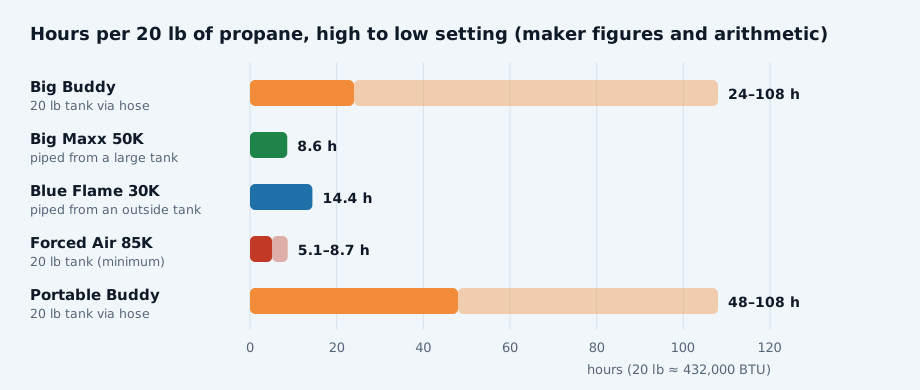
A 20 lb tank holds about 432,000 BTU, roughly 48 hours at 9,000 BTU/h by arithmetic, and less in deep cold. The tank stays outside and feeds the heater through a Buddy hose, with the fuel filter the manual specifies.
Never refill the disposable 1 lb cylinders, whatever an adapter listing promises. The federal pipeline and hazmat agency, PHMSA, warns against refilling them, because they are not built for it.
Fresh air comes free
A cheap heater is unvented like the dearer portables. It burns the garage’s oxygen and leaves carbon dioxide, water vapor and possibly carbon monoxide in the air you breathe.
The Portable Buddy manual asks for a 9 sq in vent area, and the ODS shuts it off if oxygen runs low. That sensor watches oxygen, not CO, so a battery CO alarm on the wall is part of the purchase.
Our guide to fresh air for a garage heater shows where to make the openings. Never run it with gasoline, solvent or paint fumes in the air, and never sleep in the garage with it lit.
When the Big Buddy pays you back
| Heater | Type | Heat output | Rated area | Price band |
|---|---|---|---|---|
| Portable Buddy | Portable radiant | 4,000–9,000 BTU/h | About 225 sq ft | $ |
| Big Buddy | Portable radiant | 4,000–18,000 BTU/h | About 450 sq ft | $$ |
| Blue Flame 30,000 BTU | Vent-free wall | 30,000 BTU/h | Up to 1,000 sq ft | $$ |
| Forced air 85,000 BTU | Torpedo | 50,000–85,000 BTU/h | Up to 2,125 sq ft | $$ |
| Big Maxx 50,000 BTU | Vented unit heater | 50,000 BTU/h input | Up to 1,667 sq ft | $$$ |
The full comparison table on the homepage adds fuel, power and venting for all five.
The Mr. Heater Big Buddy is the natural step up. It doubles the output to 18,000 BTU/h, adds a third setting, accepts a pair of small cylinders or a hose to a 20 lb tank, and carries a 3-year limited warranty on its listing.
If you work in a two-car garage, or spend whole weekends out there, that extra heat matters more than the band. The Big Buddy review covers its 18 sq in vent rule and the pilot complaints some owners raise.
An electric garage heater is a different route with no combustion at all. It needs a circuit sized for it, and it is outside what this site compares.
Cheap traps to skip
Skip any cheap torpedo heater as a way to keep a closed garage warm. Forced-air heaters throw every bit of their exhaust into the room and want large fresh-air openings, so they suit short, attended warm-ups in a ventilated shop.
Skip bringing the 20 lb tank inside to save on hose length. The Buddy manuals say a tank that size stays outdoors, and spare cylinders belong outside too, upright and away from heat.
Skip unbranded heaters with no ODS or tip-over switch mentioned on the listing. And never warm up the car or run a generator in the garage, even with the door open.
A cheap heater is only as safe as the garage you run it in. Give it the vent area its manual asks for, keep 30 in above it and 24 in in front of it clear, and park it away from the car, rags and fuel cans.
Fit a battery CO alarm before the first cold morning, and switch the heater off whenever you leave the garage.
Our pick if you want to spend the least
For spot heat at a bench in a one-car garage, the Portable Buddy is the under-$150 heater we would choose, with an ODS, a tip-over switch and a 20 lb tank option. Buy it expecting warmth around you, not a warm garage.
