Torpedo or Blue Flame, two fast garage heaters
The torpedo blasts 50,000 to 85,000 BTU of hot air from a 20 lb tank and a wall outlet. The Blue Flame hangs on the wall, runs from a gas line and holds a thermostat setting at 30,000 BTU. Both leave their exhaust in the garage.
The torpedo for a fast warm-up with fresh air, the Blue Flame for steady heat
If you walk into a frozen shop, need it workable in a quarter of an hour, and can open generous fresh-air gaps, the 85,000 BTU forced air heater does that. Owners describe a shop reaching 50 °F in about 15 minutes.
The Blue Flame 30,000 BTU suits a garage you heat for hours at a time. It sits on the wall, holds a set temperature with its thermostat and needs no outlet, though it still wants a gas line and fresh air.
Both are on our list of the best propane garage heaters, the torpedo as the fast warm-up pick and the wall unit as the wall heater pick. The Blue Flame also faces the vented Big Maxx and the portable Big Buddy.
85,000 BTU torpedo and Blue Flame side by side
Numbers below are from the Amazon.com listings plus Mr. Heater’s manuals. Where a 20 lb run time is not on the listing, the figure is our own sum.
| Feature | Forced air 85,000 BTU (MH85QFAV) | Blue Flame 30,000 BTU (MHVFDF30BFT) |
|---|---|---|
| Type | Portable direct-fired forced-air (“torpedo”) heater | Wall-hung vent-free blue flame unit |
| Heat output | 50,000–85,000 BTU/h, variable | 30,000 BTU/h |
| Rated area | Up to 2,125 sq ft (listing) | 1,000 sq ft per the listing |
| Fuel and tank | 20 lb tank minimum, kept 7 ft away; hose and regulator included | Dual fuel (LP or natural gas) on a fixed gas line |
| Run time | Up to 8.5 h per tank (listing); about 5 h on high by arithmetic | About 14 h per 20 lb (arithmetic); usually a bigger tank |
| Power needed | 115 V, 2 A, 230 W for the fan (manual) | None, battery spark ignition |
| Thermostat | None, and none can be used (manual) | Built in, adjustable |
| Venting and fresh air | No flue; two 2 sq ft openings, one low and one high (manual) | No flue; Mr. Heater requires outside air for it |
| Safety devices | High-temperature limit | Low-oxygen shut-off (ODS) |
| Install | None; stands on the floor with wide clearances | Wall mount; gas line by a licensed installer |
| Weight | 14.18 lb (listing) | 26.1 lb |
| Price band | $$, $150 to $300 | $$, $150 to $300 |
| Warranty | 1 year, limited | 1 year, limited |
Heat and warm-up speed
On paper the torpedo makes almost three times the Blue Flame’s heat, adjustable from 50,000 to 85,000 BTU. A fan pushes it out in a hot stream, which is why owners talk about minutes rather than hours.
The Blue Flame warms by convection at 30,000 BTU. The garage comes up slowly and evenly, and once it is warm the thermostat holds it there. That covers an insulated two-car garage by the usual rule of thumb, while a drafty three-car shop may leave it lagging.
Both ratings, 2,125 sq ft for the torpedo and 1,000 sq ft for the wall heater, assume mild weather. Volume in cubic feet, times the warming you want, times 0.133 gives a truer target for an insulated space.
Round goes to the torpedo, on raw heat and speed.
Fuel and running
The torpedo goes through 2.3 to 3.9 lb of propane per hour, per its manual. A 20 lb tank therefore lasts about 5 hours on high and close to 9 on low by arithmetic, and the listing quotes up to 8.5 hours.
The manual also warns that a small cylinder cannot sustain full output in cold weather. As the tank chills, vapor pressure falls and the flame sags, which our guide to propane in a freezing garage explains along with the tank sizes that hold up.
The Blue Flame burns about 1.4 lb an hour at full output, using roughly 21,600 BTU per pound, and its thermostat cycles it off once the garage is warm. Fed from a large outdoor tank, it rarely runs short.
Round goes to the Blue Flame, for fuel per hour and a supply that copes with cold.
Setup and power
The torpedo needs a grounded three-prong outlet for its 230 W fan, a 20 lb tank at least 7 ft away, and floor space. Clearances are 6 ft in front of the outlet and above it, 2 ft at the sides and rear, and 10 ft from tarps.
The Blue Flame needs a wall, the mounting hardware in the box and a fixed gas line run by a licensed installer or the propane supplier. It needs no electricity, so a power cut does not stop it.
Round goes to the torpedo for a shop with no gas line, the Blue Flame for a permanent setup.
Air quality, CO and fire safety
This round matters most. Both put all of their exhaust into the garage, so carbon dioxide, water vapor and possibly carbon monoxide stay in the air you breathe. At 3.9 lb of propane an hour, the torpedo leaves over 6 lb of water vapor in that hour alone.
Its manual rules out home and RV use and wants two openings of 2 sq ft each, one low and one high. Think of it as a warm-up machine for a ventilated work area, run while you stand by, and never while you are away or asleep.
The Blue Flame burns far less per hour and has an ODS, which cuts it off when oxygen drops. That sensor does not detect CO, so a battery CO alarm belongs on the wall with either heater. Read where carbon monoxide gathers in a garage first.
Neither may run with gasoline, solvent or paint thinner fumes in the air. The torpedo’s hot outlet must never point at its own tank, and the car stays well outside its 6 ft clearance.
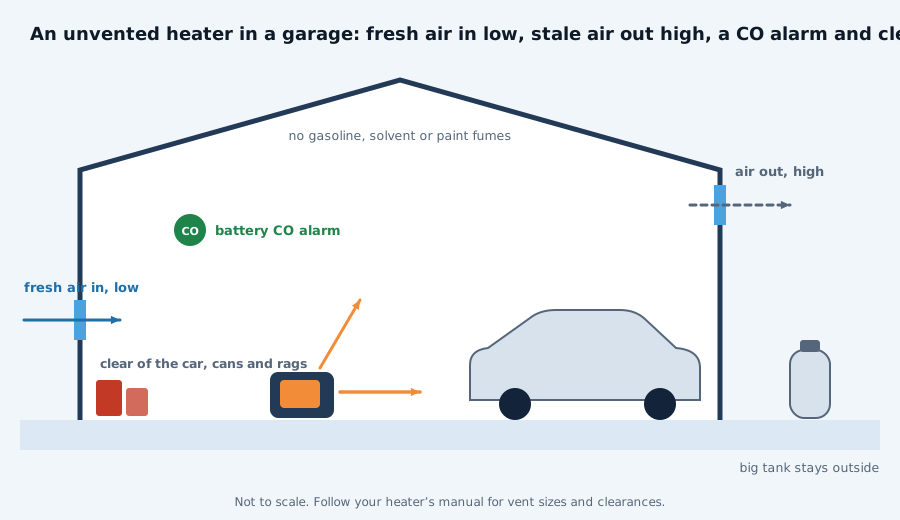
Round goes to the Blue Flame, with a smaller exhaust load and an oxygen sensor.
Comfort, noise and moisture
The torpedo has no thermostat and none can be fitted, so it runs until you turn it down or off. Owners give mixed reports on the noise of its fan, despite the Quiet Burner name.
The Blue Flame makes little more than a soft burner sound, and the thermostat keeps the swing small. The shared problem is moisture, since water vapor that meets cold tools and windows condenses, and our guide to wet floors and rust in a heated garage shows how to keep it down.
Round goes to the Blue Flame, quieter and steadier.
Price and value
The two share the $$ band ($150 to $300) and a 1-year limited warranty. The torpedo comes with its hose and regulator, so you add only a 20 lb tank.
Beyond the heater itself, the Blue Flame needs its gas line and installer, maybe a larger tank too, which together can cost more than the heater. Owners of each call it good value, the torpedo for its heat and the Blue Flame for its steady thermostat.
Round goes to the torpedo, cheaper to get running.
The torpedo’s catch is a manual that rules it out for homes and wants big openings low and high, so it suits a ventilated shop for an hour, not a closed garage all evening. The Blue Flame’s catch is a fixed gas line, a code check and exhaust that still stays inside.
A blast or a steady glow
Pick the torpedo if you need a cold, ventilated shop warm in minutes and will stay with it the whole time it runs. Choose the Blue Flame for a garage you keep at a set temperature for hours, with a gas line in place and a CO alarm on the wall.