Fresh air for a garage heater, in square inches
Every unvented propane heater breathes the air in your garage and leaves its exhaust behind. The manuals put a number on the fresh air it needs, from a fist-sized hole for a small Buddy to two square feet top and bottom for a torpedo.
Why a heater needs fresh air
A flame needs oxygen, and an unvented heater takes it from the air in your garage. What comes back is carbon dioxide and water vapor, plus some carbon monoxide if the burn is poor.
Fresh air does two jobs at once. It replaces the oxygen the flame uses and carries the exhaust out before it builds up, which is why the manuals ask for openings even in a drafty garage.
The rule covers the Big Buddy, the Portable Buddy, the Blue Flame wall heater and the torpedo. A vented unit heater works differently, and the guide to vented or vent-free heaters explains why.
The openings each manual asks for
| Heater | Fresh air the maker asks for | Source |
|---|---|---|
| Portable Buddy, 9,000 BTU | 9 sq in, about 3 × 3 in | Manual |
| Big Buddy, 18,000 BTU | 18 sq in (roughly a 4.25 in square), one high and one low | Manual |
| Blue Flame, 30,000 BTU | Outside ventilation air; the ODS shuts it down if there is not enough | Maker |
| Forced air, 85,000 BTU | 2 sq ft or more down low, plus 2 sq ft up high | Manual |
| Big Maxx unit heater | Exhaust leaves through the flue; the installer checks combustion air per the manual and code | Manual |
The jump in that table is the point. Two square feet is 288 sq in, sixteen times the Big Buddy’s opening, because the torpedo burns several times as much propane and puts all of its exhaust into the room.
Treat the manual for your own model as the final word. Sizes differ between models, and a heater that came with a different manual from the one described here follows its own figures.
Low in, high out
Warm exhaust rises, so stale air leaves best through an opening near the ceiling. Fresh air comes in best near the floor, and the Big Buddy and torpedo manuals ask for one of each.
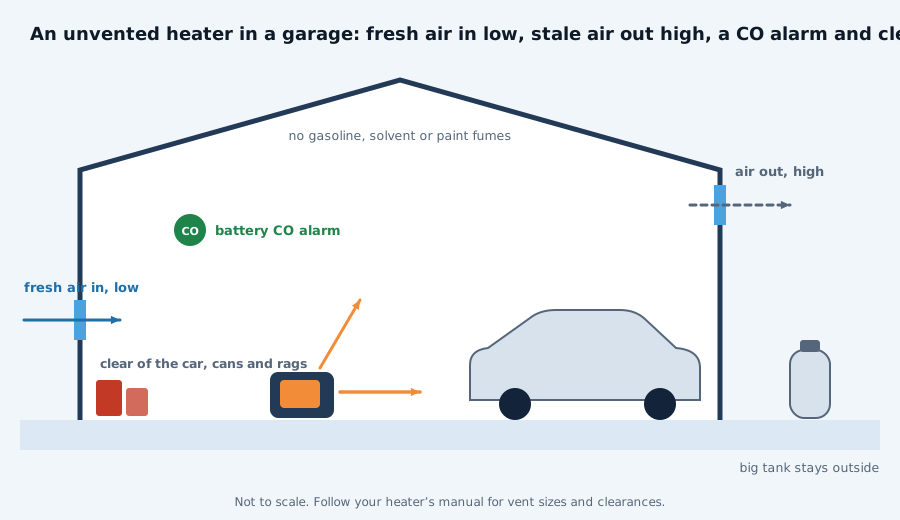
In a garage, a high window cracked open and a low vent on another wall can do the job if they add up to the manual’s area. A garage door raised a few inches makes a long low slot, often the easiest low opening.
Keep the openings open the whole time the heater runs. Snow, a draft stopper or a tarp over the window turns a ventilated garage back into a closed box.
A rough check on garage volume
The National Fuel Gas Code treats a space as confined when it has less than 50 cubic feet per 1,000 BTU/h of appliance input. Run the numbers for the 30,000 BTU Blue Flame and it calls for 1,500 cu ft or more, or else extra air piped in from outdoors.
A typical two-car garage of 24 × 24 × 9 ft holds about 5,184 cu ft. Plenty of volume does not cancel the manual, though, since the openings replace the oxygen and carry the water vapor out over the hours.
Volume also sets how hard the heater has to work. The guide to sizing a garage heater uses the same cubic feet to estimate BTUs.
What the ODS does, and does not
Both Buddy heaters and the Blue Flame are fitted with an oxygen depletion sensor, a pilot that shuts the gas off when oxygen drops. It is a backup for poor ventilation, never a substitute for it.
An ODS senses low oxygen, not carbon monoxide. A heater can make CO with oxygen to spare, so every garage with an unvented heater needs a battery CO alarm, and the guide to carbon monoxide in a garage shows where it builds.
An ODS that trips often is a message. The garage is short of fresh air, and the fix is a bigger opening, not a trick to keep the heater lit.
Fumes, cars and the house door
- Never run a heater where gasoline, solvent or paint thinner fumes are in the air
- Store fuel cans well away from the heater, since gasoline vapor sinks and collects along the floor
- Never run a car or generator in the garage, even with the door open
- Keep the door to the house closed and put a CO alarm on the house side too
- Switch the heater off before you sleep, and never sleep in the garage with it running
Opening the garage for fresh air does not make it safe to run an engine inside. Warm up the car outside, and if the CO alarm sounds, switch the heater off and get everyone into fresh air.
Fresh air and a wet garage
The same openings that bring oxygen in also carry water vapor out. Each pound of propane you burn turns into roughly 1.6 lb of water, so a closed garage with an unvented heater turns damp fast.
If your windows stream and your tools rust, ventilation is half the answer. The guide to heater condensation and rust covers the other half.
Heat loss is the trade-off
Every opening lets warm air out, which can feel like throwing heat away. The answer is to size the openings to the manual rather than close them, and to pick a heater that suits how often you use the garage.
A vent-free wall heater such as the Blue Flame 30,000 BTU holds temperature on a built-in thermostat but still needs outside air. A vented unit heater such as the Big Maxx sends its exhaust up a flue, so the garage stays shut.
Mr. Heater makes all five heaters here, and the guide to garage heater brands names the alternatives. If you are still deciding which garage heater to buy, start with our top pick, the Big Buddy, and the before-you-buy tips.
If you would rather not crack a door
The Big Maxx sends its exhaust and water vapor outside through a flue and runs on a wall thermostat. It sits in the highest price band and needs a qualified installer for the gas line, the vent and the power, so it makes sense for a garage in use most winter days.