Best Propane Garage Heater for Winter Work

Breath fogging over the workbench?

Then skip the endless scroll of look-alike heaters. We picked five after reading the listings, Mr. Heater’s manuals and what owners report after a winter in a cold garage. There’s one for every garage, from a vented ceiling unit to a 9,000 BTU Buddy you carry to the bench, each with its catch said plainly.

  • Warm hands at the benchFrom quick spot heat for one corner to a thermostat that holds the whole bay all winter
  • Fresh air and a CO alarmEvery unvented heater here burns your garage’s air, so give it an opening and an alarm on the wall

In a hurry? Our top pick is the Mr. Heater Big Buddy, an 18,000 BTU radiant heater certified for indoor use that needs no install and no outlet, as long as you give it fresh air and a CO alarm.

Compare all 5 heaters

If you only have a minute

Which propane garage heater should you buy?

Say a neighbor leaned on the garage door and asked which heater to get before the first hard frost. This is what we would tell them.

For most garages, the Mr. Heater Big Buddy. It is certified for indoor use, gives up to 18,000 BTU with no install and runs from a 20 lb tank kept outside. Give it the fresh-air openings its manual asks for and a CO alarm on the wall.

Heating a garage you own all winter? The Big Maxx unit heater vents its exhaust through a flue to the outdoors, but needs a pro install, a gas line and a 10 ft ceiling. On a tight budget, the Portable Buddy warms one bench (the two Buddies, compared).

Want a thermostat without a flue? The Blue Flame wall heater holds a set temperature from a gas line. Need a frozen shop warm in minutes, with the door open? The 85,000 BTU torpedo does that, attended.

Whichever you pick, read where carbon monoxide builds in a garage and the eight things the listing leaves out before the first cold morning.

Our top pick

The garage heater we would buy first: Mr. Heater Big Buddy

Not the most powerful and not vented. It is the one most garages can use the day it arrives, with no installer, no wiring and the safety devices an indoor heater should carry.

Mr. Heater Big Buddy portable propane radiant heater in red and black with a fold-down handle Our top pick

Mr. Heater Big Buddy MH18B, 18,000 BTU

Price band $$ An indoor-certified portable from the biggest name in propane garage heat

The Big Buddy is a radiant heater you set on the floor and aim at the bench or the car you are working on. It has three settings, 4,000, 9,000 and 18,000 BTU, and the listing rates it for about 450 sq ft.

Mr. Heater certifies it for indoor use and fits a low-oxygen shut-off (ODS) and a tip-over switch. It needs no electricity, since the current “NF” model has no fan, and a piezo button lights it.

Fuel comes from one or two disposable 1 lb cylinders or, better, a 20 lb tank that stays outdoors and feeds it through a Buddy hose. On that tank the manual quotes 24 to 108 hours, and the listing carries a 3-year limited warranty.

Heat output
4,000, 9,000 or 18,000 BTU
Rated area
About 450 sq ft (listing)
Fuel
1 lb cylinders or an outdoor 20 lb tank via hose
Run time
24 to 108 h per 20 lb (manual)
Power
None, no fan
Safety
ODS and tip-over switch
Fresh air
18 sq in at ceiling and floor (manual)
Weight
13.01 lb listed, 17.1 lb per Mr. Heater
Price band $$ $150 to $300 · price on Amazon

Your setup, step by step

No installer is involved, but the fresh air and the alarm are part of the job. Do them in this order before the first cold morning, and repeat the second half every time you light it.

Before you light it

  • Make two fresh-air openings of 18 sq in, one near the ceiling and one near the floor
  • Hang a battery CO alarm in the garage, and one in the house if the garage is attached
  • Leave 30 in of space overhead, 2 ft in front and 6 in on each side, away from the car, rags and cans
  • Stand the 20 lb tank outside, upright, and run a Buddy hose in to the heater

Then light it and stay with it

Every time you use it

  • Leak-check a new hose joint with soapy water before the first run
  • Light it with the piezo button and start on low or medium
  • Switch it off at once if you smell gasoline, solvent or paint
  • Turn it off and close the tank before you leave the garage or rest

What it has, and what it lacks

What it has
  • Indoor certification, an ODS and a tip-over switch
  • Three settings from 4,000 to 18,000 BTU
  • No install, no outlet and no fan noise
  • A day or more of heat from a 20 lb tank outside
  • A 3-year limited warranty on the listing
What it lacks
  • A flue, its exhaust and moisture stay in the garage
  • A thermostat, you turn it up and down by hand
  • Whole-room heat in a cold, uninsulated two-car bay
  • A clean record, some owners say it will not stay lit

Between us, before you order

Indoor-certified does not mean vented. Its carbon dioxide, water vapor and any carbon monoxide stay in the air you breathe, so the two 18 sq in openings and a battery CO alarm are part of owning one, and nobody sleeps in the garage while it burns.

At 18,000 BTU it warms you and the bench in a cold two-car garage, not the far corner. A one-car or insulated garage can get comfortable, and if you end up heating all winter, the vented Big Maxx is the upgrade.

What owners report

Owners say it lifts a room by about 20 °F in half an hour, and many run it through the winter in garages and workshops. Good value is a theme that keeps coming up.

The recurring complaint is a heater that stays lit only a few minutes or quits after about 15, usually the pilot or the ODS. Fresh air, a full tank and a filtered hose come first, as our seven fixes explain.

Buy it if

You want heat this week without an installer, you rent or work in the garage on some days, and you will give it fresh air and a CO alarm.

Skip it if

Ready for warm hands this winter?

Add a 20 lb tank outside, a Buddy hose, two fresh-air openings and a battery CO alarm. With those in place, the Big Buddy is where we would start in almost any garage.
Size and fuel

Three heater sizes, and the garage each one suits

Every heater here burns propane. What differs is how much heat it makes, where its exhaust goes, and how long a 20 lb tank lasts.

Spot heat · one bench or a one-car garage

Warm you, not the room

Portable Buddy, Big Buddy

9,000 to 18,000 BTUrated for about 225 to 450 sq ft

Radiant heaters warm what they face. They suit a bench, a one-car garage or a modest two-car bay in mild cold, with fresh air and a CO alarm.

Whole garage · two or three cars

Heat that holds all day

Blue Flame, Big Maxx

30,000 to 50,000 BTUrated for 1,000 to 1,667 sq ft

By a rough rule, an insulated 24 × 24 × 9 ft garage takes about 27,600 BTU for a 40 °F rise. A thermostat and a gas line from a big tank do the rest.

Warm-up · a cold, ventilated shop

Fast, loud and attended

85,000 BTU torpedo

50,000 to 85,000 BTUrated for up to 2,125 sq ft

A forced-air torpedo heats a frozen shop in minutes, but its manual wants 2 sq ft of opening low and high. Use it for short warm-ups, never in a closed garage.

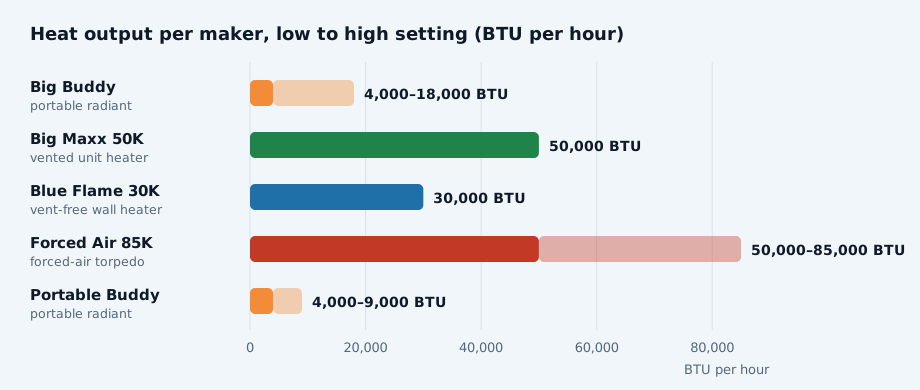
Bar chart of the rated heat output of the five propane garage heaters in BTU per hour, from the low to the high setting where the maker gives both
Heat output as rated by Mr. Heater. Green is the vented unit heater, blue the vent-free wall heater, orange the portable radiant Buddies and red the forced-air torpedo. The Big Maxx figure is input; its manual gives 40,000 BTU of output at 80% efficiency.

How long a 20 lb propane tank lasts

  • On the high setting
  • On low, where the heater has one
0 h153045607590105120

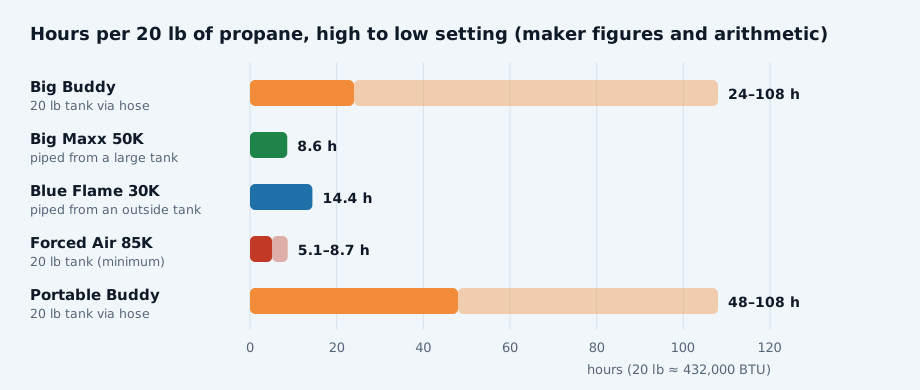
A 20 lb tank holds about 432,000 BTU (20 × 21,600). The Big Buddy figures come from Mr. Heater’s manual and the torpedo’s from its fuel rate of 2.3 to 3.9 lb an hour; the rest is our arithmetic. A cold tank gives less.

  1. Size the heatMatch the BTUs to your garage’s cubic feet and insulation, not to the biggest number on the box. How many BTUs
  2. Plan the propaneCylinders for a Buddy, a 20 lb tank outside on a hose, or a big tank on a gas line. Feeding the heater
  3. Give it fresh airUnvented heaters burn the garage’s oxygen, so open what the manual asks for, low and high. Fresh air
  4. Hang a CO alarmA battery CO alarm is the one thing that warns you before you feel ill. Carbon monoxide

Tank frosting over on a cold morning? Our guide to propane in the cold explains why output sags and which tank keeps up.

How to choose

How to pick the right propane heater for your garage

Six points decide it. Your garage, how often you heat it and where the exhaust goes matter more than the BTU number on the box.

Heat output and garage size

Cubic feet times degrees of warming times 0.133 gives a starting BTU figure for an insulated bay, and bare studs need half again. Maker area figures assume mild weather. Size your heater.

Vented or vent-free

A vented heater like the Big Maxx sends CO and moisture out through a flue. Vent-free and portable heaters leave both in the garage. The difference.

Fixed or portable

A fixed heater needs a gas line and a pro, then runs on a thermostat. A Buddy needs nothing but a cylinder or a hose. Unit heater or Big Buddy.

Propane supply

Disposable 1 lb cylinders empty in hours, and a 20 lb tank stays outside on a hose. Fixed heaters want a big tank and a gas line. Tank options.

Fresh air and CO

Every unvented heater needs openings sized by its manual, and a low-oxygen sensor does not detect CO. A battery CO alarm goes on the wall. How much air.

Moisture and rust

Burned propane turns into water, roughly 1.6 lb per pound of fuel. Without a flue it lands on cold tools, windows and the car. Keeping it dry.

The 5 heaters

Five propane garage heaters, side by side

Our top pick first, then the vented unit heater for permanent heat, the wall heater, the torpedo and the small Buddy. All five are Mr. Heater, because it dominates propane garage heat on Amazon.com, and each card names the catch.

Mr. Heater Big Buddy portable propane radiant heater in red and black with a fold-down handle Our top pick

Mr. Heater Big Buddy MH18B

The one we would buy first: real heat, no install, nothing to plug in.

  • TypePortable radiant, certified for indoor use
  • Heat4,000, 9,000 or 18,000 BTU
  • AreaUp to about 450 sq ft
  • Fuel1 lb cylinders (one or two) or a 20 lb tank on a hose
  • SafetyLow-oxygen shut-off, tip-over switch
  • Ideal forMost garages, from one bay to a corner of two

Good to know: Its manual sizes the fresh-air openings at 18 sq in, low and high, and a CO alarm belongs on the wall. Some owners report it going out after a few minutes. Big Buddy or the Blue Flame.

Read the full Big Buddy review

$$$150 to $300
Mr. Heater Big Maxx MHU50 ceiling-mounted garage unit heater with its louvered front and mounting brackets Best permanent heater

Mr. Heater Big Maxx MHU50

The upgrade for a garage you heat all winter.

  • TypeVented ceiling unit heater with a blower
  • Heat50,000 BTU input, 40,000 BTU output
  • AreaRated for a three-car garage, 1,667 sq ft
  • FuelGas line from a large tank, LP kit in the box
  • Controls24 V or Wi-Fi wall thermostat, sold separately
  • Ideal forGarages you own and heat all winter

Good to know: It needs a pro install with the LP conversion, a 4 in vent, a 120 V circuit and a 10 ft ceiling, and a few owners report damaged arrivals. Big Maxx against the Blue Flame.

Read the full Big Maxx review

$$$over $300
Mr. Heater 30,000 BTU vent-free blue flame wall heater with a black cabinet and top grille Wall heater pick

Mr. Heater Blue Flame 30,000 BTU

A thermostat on the wall, no outlet needed.

  • TypeVent-free blue flame convection, wall mount
  • Heat30,000 BTU
  • AreaUp to 1,000 sq ft (listing)
  • FuelPropane or natural gas, fixed gas line
  • ControlsBuilt-in thermostat, battery spark ignition
  • Ideal forInsulated garages heated most evenings

Good to know: Its exhaust and moisture stay in the garage, so it needs outside ventilation air. Not for California, and check local codes for vent-free heaters. Fresh air it needs.

Read the full Blue Flame review

$$$150 to $300
Mr. Heater 85,000 BTU forced air propane torpedo heater with a yellow body and hose with regulator Fast warm-up

Mr. Heater 85,000 BTU Forced Air

A frozen shop workable in minutes, with rules.

  • TypePortable forced-air torpedo, 115 V fan
  • Heat50,000 to 85,000 BTU, variable
  • Fuel2.3 to 3.9 lb an hour from a 20 lb tank or bigger
  • Fresh air2 sq ft open low and 2 sq ft high (manual)
  • Clearance6 ft from the outlet, tank 7 ft away
  • Ideal forShort warm-ups in a ventilated work area

Good to know: Its manual says not for home use, it takes no thermostat, and all its exhaust stays in the shop. Stay with it while it runs. Torpedo or Blue Flame.

Read the full forced air review

$$$150 to $300
Mr. Heater Portable Buddy compact red propane radiant heater with a ceramic burner and carry handle Budget spot heat

Mr. Heater Portable Buddy MH9BX

Warm hands at the bench for the least money.

  • TypePortable radiant, certified for indoor use
  • Heat4,000 or 9,000 BTU
  • AreaUp to about 225 sq ft
  • FuelOne 1 lb cylinder, 2.4 h on high (listing)
  • Weight7.1 lb on the listing
  • Ideal forOne bench in a one-car garage

Good to know: 9,000 BTU is spot heat, too little for a cold two-car bay, and pilot problems turn up in owner reports. It needs a 9 sq in fresh-air opening. How much heat you need.

Read the full Portable Buddy review

$under $150

Honest note: these are Amazon affiliate links. As an Amazon Associate we earn from qualifying purchases at no cost to you, and it changes nothing about the order or the catches we name.

Before you buy

Eight things about propane garage heaters no listing prints in big letters

None of these sits at the top of a product page, and all eight shape your first winter with a propane heater in the garage.

What you should know

  1. Unvented means the exhaust stays. A Buddy, a Blue Flame or a torpedo leaves its carbon dioxide, water vapor and any CO in the garage you breathe in. Where CO builds
  2. The low-oxygen sensor is not a CO alarm. It shuts the heater off when oxygen drops and never senses carbon monoxide. Hang a battery CO alarm on the wall, and one in the house too
  3. Fresh air is part of the install. Each manual sizes the openings, from 9 sq in for the Portable Buddy to 2 sq ft low and high for the torpedo. How much air
  4. Gas fumes and flames do not mix. Never run a heater with gasoline, solvent or paint fumes in the air. Gasoline vapor sinks and pools at floor level. Nine safety rules
  5. The 20 lb tank stays outside. A portable Buddy can run from one on a hose, but the tank never comes indoors, and disposable 1 lb cylinders are never refilled. Tank setup
  6. Cold tanks give less. As a tank chills, its pressure falls and the flame sags, and small tanks frost over under a big heater. Propane in the cold
  7. Propane makes water. A pound of it burned leaves about 1.6 lb of water vapor, which ends up on cold tools and windows. Stopping the rust
  8. Pilot outages have causes. A Buddy that goes out after minutes often wants more fresh air, a fuller cylinder or a clean pilot. Seven fixes

Everything in one table

Five propane garage heaters, catch included

Each row puts a heater’s strength right next to its catch.

Swipe the table sideways to see all columns →

Heater Ideal for Band Type Heat and area Fuel and run time Strength and catch View
Mr. Heater Big Buddy MH18B (our top pick) Most garages, no install $$$150 to $300 Portable radiant
ODS, tip-over switch
4,000 to 18,000 BTU, about 450 sq ft 1 lb cylinders or 20 lb via hose; 24 to 108 h per 20 lb No install, three settings. Exhaust stays inside, some pilot outages.
Mr. Heater Big Maxx MHU50 (best permanent heater) Garages heated all winter $$$over $300 Vented unit heater
ceiling, thermostat
50,000 BTU in, rated to 1,667 sq ft Gas line from a large tank; about 8.6 h per 20 lb Exhaust and moisture go outside. Pro install, flue, 120 V, 10 ft ceiling.
Mr. Heater Blue Flame 30,000 BTU Insulated garages, most evenings $$$150 to $300 Vent-free wall heater
built-in thermostat
30,000 BTU, up to 1,000 sq ft Fixed gas line; about 14 h per 20 lb at full output Thermostat, no power needed. Gas line, code check, exhaust stays inside.
Mr. Heater 85,000 BTU Forced Air Fast warm-ups in a ventilated shop $$$150 to $300 Forced-air torpedo
115 V fan
50,000 to 85,000 BTU, up to 2,125 sq ft 20 lb tank minimum; about 5 to 9 h per tank Huge heat in minutes. Not for home use, attended only, no thermostat.
Mr. Heater Portable Buddy MH9BX One bench, small garage $under $150 Portable radiant
ODS, tip-over switch
4,000 or 9,000 BTU, about 225 sq ft 2.4 to 5.4 h per 1 lb cylinder; about 48 h per 20 lb on high Cheap, light, easy to light. Spot heat only, pilot trouble reported.

Figures from the Amazon.com listings and, where marked, Mr. Heater’s manuals. Run times per 20 lb are our arithmetic except the Big Buddy’s. Only the price Amazon shows at checkout counts.

Bar chart of how many hours each garage heater runs on 20 lb of propane, from the high to the low setting
Hours per 20 lb of propane (about 432,000 BTU). The Big Buddy figures come from Mr. Heater’s manual, the others are arithmetic from the rated input or fuel rate. Cold tanks give less, and the fixed heaters normally run from a much bigger tank.

Ready for the first hard frost

Start with the Big Buddy, set up properly

For most garages, this is the heater we would buy first. It needs no installer or outlet, puts radiant heat on you and the bench within minutes, and runs a day or more from a 20 lb tank outside.

Give it two 18 sq in fresh-air openings and a battery CO alarm, and never let it burn while anyone sleeps in the garage. If the garage later needs heat all winter, the vented Big Maxx is the step up.

$$

$150 to $300 · portable radiant heater · Mr. Heater

  • ✓ 4,000, 9,000 or 18,000 BTU
  • ✓ Certified for indoor use, ODS and tip-over switch
  • ✓ No install and no electricity
  • ✓ 24 to 108 h on a 20 lb tank (manual)

Good to know

Why a propane heater acts the way it does, in a cold, closed garage

A few minutes of background makes the quirks of a propane heater in a garage much easier to live with.

Every heater here burns propane with the oxygen in the air. The flame makes heat, carbon dioxide and water, and a poorly fed flame also makes carbon monoxide. Where those gases go is what separates the five.

01Why a flue changes everything

A vented unit heater pushes its exhaust out through a pipe. An unvented one leaves it in the garage, which is why its manual asks for openings and why a CO alarm belongs on the wall. Vented or vent-free.

02Why the windows fog up

A single pound of fuel yields close to 1.6 lb of water. Without a flue, that vapor meets cold glass, tools and the car, and condenses there.

03Why the tank frosts over

Propane stays a boiling liquid down to roughly −44 °F, which keeps it gassing off even in a frozen garage. A heavy draw chills the liquid, the pressure falls and the flame shrinks, which hits small tanks first.

A propane heater in a garage needs three things: fuel it can draw, air it can burn, and a way for the exhaust to leave.

04Why the heater shuts itself off

The low-oxygen pilot on a Buddy or a Blue Flame goes out when oxygen drops or the air gets thin, so it can also trip at altitude. That is a backup, never a reason to skip the fresh air.

~21,600 BTUEnergy in a pound of propane

~432,000 BTUIn a full 20 lb tank

1.6 lbWater made per pound burned

−44 °FWhere propane stops boiling

Want the full safety picture? Read the nine safety rules before your first cold morning.

Questions and answers

Frequently asked questions about propane garage heaters

Twelve questions that come up again and again, with full answers.

What is the best propane garage heater?

For most garages, the Mr. Heater Big Buddy, an indoor-certified portable with an ODS and a tip-over switch that needs no install, given fresh air and a CO alarm. For a garage you own and heat all winter, the vented Big Maxx. All five sit in the comparison table.

Can a propane heater run safely with the garage shut tight?

Not fully closed. Indoor-rated unvented heaters still need the fresh-air openings their manuals list, a battery CO alarm, and no gasoline or solvent fumes nearby. Never sleep in a garage with one running. The nine rules.

How many BTUs does a two-car garage need?

Take an insulated 24 by 24 ft garage, 9 ft high, that you want 40 °F warmer than outside. Our rule of thumb puts that near 27,600 BTU, and bare studs push it up by half or more. Size it yourself.

How long does a 20 lb propane tank last in a garage heater?

Divide roughly 432,000 BTU, the energy in a full 20 lb tank, by the heater’s hourly rating. A Big Buddy on high gets about a day and the torpedo around five hours. Cold tanks give less, and the Big Buddy manual quotes 24 to 108 hours.

Vented or vent-free, what changes in the garage?

A vented heater sends its exhaust and moisture outside through a flue. A vent-free heater leaves them in the room and relies on fresh air and a low-oxygen sensor. Some places, such as Massachusetts and Canada, restrict unvented propane heaters indoors. The details.

Do I need a CO alarm in my garage?

Yes, with any of these heaters. A low-oxygen sensor does not detect carbon monoxide. Pick a battery unit or a plug-in model that keeps a battery as backup, and add one in the house if the garage is attached. Carbon monoxide.

Can I bring a 20 lb propane tank into the garage?

No, if it feeds a portable. Mr. Heater wants that tank outdoors on a hose, and spare cylinders are stored outside as well, standing upright, far from anything hot. Fixed heaters run from a tank outdoors through a gas line. Tank setup.

Why does my propane heater make the garage wet?

Water is one of the two things a propane flame produces, close to 1.6 lb per pound burned. An unvented heater leaves it all in the air, so it settles on cold tools, windows and the floor. A flue or more fresh air fixes it. Stopping condensation.

Can I install a propane unit heater myself?

Not by the book. Mr. Heater wants a gas pro or the propane supplier to hang the Big Maxx and convert it to LP. Fixed gas lines belong to a licensed pro, with a permit where required. What the install involves.

Why won’t my Buddy heater stay lit?

Often the low-oxygen pilot is doing its job, because the garage lacks fresh air. A cold or nearly empty cylinder, a dirty pilot, a missing fuel filter on the hose or altitude above about 7,000 ft can also cause it. Seven fixes.

Why don’t you show prices?

They change often, so a fixed price here would soon be wrong. We give a band instead ($ under $150, $$ $150 to $300, $$$ over $300), and the button takes you to the product page, where the price at checkout counts.

Did you test these heaters yourselves?

No, and we say so openly. We read the listings, Mr. Heater’s manuals and owner reports. Where sources disagree or a figure comes from the maker, we show where each number comes from.

Reviews

A closer look at each heater

Each review sets the full specs next to what owners report, and names the rivals worth a look.

Head-to-head

Torn between two? Four matchups, settled

Small Buddy against big, wall against floor, wall heater against torpedo, and vented against vent-free.

Read before you buy

Guides to safe, steady heat in your garage

Ten background guides, three buying guides and a glossary. Each gives the long answer instead of the short one.