Wet floors and rust from a heater, and how to stop it
You fire up a portable heater, the garage warms, and an hour later the windows stream and the floor looks wet. The heater did not leak. It made the water, and how you vent the garage decides where that water ends up.
Where the water comes from
Propane is made of carbon and hydrogen. When it burns, the hydrogen joins oxygen and becomes water, about 1.6 lb of it for every pound of propane.
A vented heater sends that water up its flue with the rest of the exhaust. An unvented heater, whether a Buddy, a blue flame wall heater or a torpedo, leaves all of it in your garage as vapor.
Warm air holds that vapor for a while. Then it meets something cold, cools below its dew point and turns back into liquid on the surface, a process the glossary calls condensation.
How much water a heater makes
The figures below are arithmetic, using about 21,600 BTU per pound of propane and 1.6 lb of water per pound burned. A gallon of water weighs about 8.3 lb.
| Heater and setting | Propane per hour | Water per hour |
|---|---|---|
| Portable Buddy, 9,000 BTU | About 0.42 lb | About 0.67 lb |
| Big Buddy, 18,000 BTU | About 0.83 lb | About 1.3 lb |
| Blue Flame, 30,000 BTU | About 1.4 lb | About 2.2 lb |
| Forced air, 85,000 BTU | 3.9 lb (manual) | About 6.2 lb |
A full 20 lb tank burned in a closed garage leaves about 32 lb of water behind, close to 4 gallons. Some of it escapes through cracks and openings, and the rest ends up on your windows, tools, car and floor.
Why it lands on your tools
Condensation forms on the coldest things in the room. In a garage that means the concrete slab, the steel of your tools and toolbox, the car body and single-pane windows.
A slab that sat at freezing all night stays cold long after the air warms. That is why a heated garage often looks wetter than an unheated one, with damp concrete under the car and beads on every wrench.
A car driven in with snow on it adds its own water as the snow melts. On a cold morning that alone can make the floor slick before the heater does anything.
Radiant heat and warm surfaces
Radiant heaters such as the Big Buddy warm what they face rather than the air. Tools on a bench in front of one warm up with you, which helps keep them above the point where water settles.
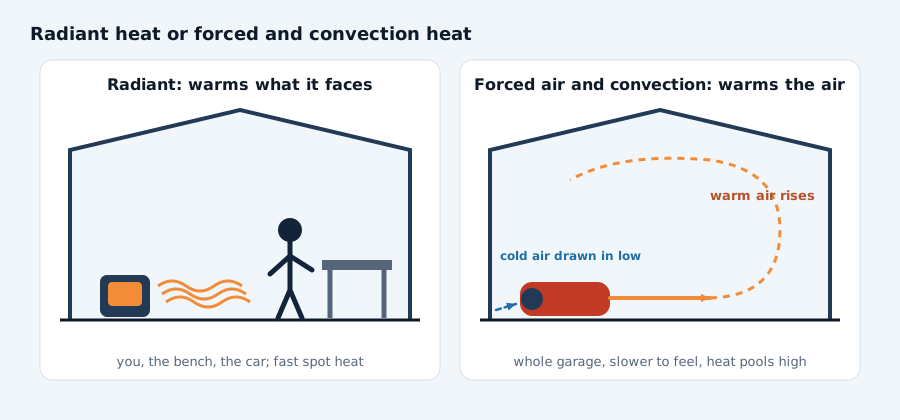
Forced-air and convection heaters warm the air first, and the heat pools high under the ceiling. The warm air holds more vapor, but the floor and the far corners stay cold, so that is where the water lands.
Neither type removes water from the garage. Only fresh air or a flue does that, which is the heart of the fix.
Six ways to a drier garage
- Give the heater the fresh-air openings its manual asks for, one low and one high
- Run a portable heater for the session you work, not around the clock
- Brush snow and ice off the car outside before you pull in
- Insulate the walls and the door, so surfaces stay warmer and need less heat
- Wipe and oil bare steel tools, and keep the good ones in a closed box
- Let the garage air out for a while after the heater goes off
Fresh air does most of the work. The guide to how much fresh air a heater needs gives the opening size for each heater, and the openings grow with the BTUs.
Bigger heater, more water
The water scales with the propane you burn, so an oversized heater on high makes the most. A torpedo puts about 6 lb of water an hour into the air, and its manual already restricts it to well-ventilated areas.
A heater sized to the garage can drop to a lower setting once the space is warm, and it burns less propane doing it. The guide to garage heater BTUs shows how to size one without overshooting.
Cold weather adds a twist. A frosted tank in a freezing garage can sag and leave you running the heater longer, which the guide to propane in the cold explains.
The fix that removes the water
A vented heater is the only one here that sends its water outside. The Big Maxx unit heater pushes its exhaust through a flue, so the vapor never meets your tools.
The guide to vented and vent-free heaters sets out the trade. A vent-free heater is cheaper to fit and needs no flue, while a vented one costs more and keeps the garage drier and the air cleaner.
Never seal up a garage to stop the drafts that seem to make it colder. Closing in an unvented heater traps its water vapor and its carbon monoxide together, so keep the openings open and a battery CO alarm on the wall.
A dehumidifier, and its limits
An electric dehumidifier pulls water from the air, and it can help in a garage you keep above freezing. Many models are made for warm rooms, so check the low-temperature limit in the specs before you buy one.
It treats the symptom, though. Ventilation or a flue deals with the cause, so set those up first and add a dehumidifier only if the garage still runs damp.
When dry air matters most
If you keep a car, a machine tool or a wall of hand tools in the garage, rust costs real money over a few winters. That is the garage where a vented heater earns its higher price in more than comfort.
The Big Maxx review covers the gas line, vent, wiring and LP conversion it needs, all work for a qualified installer. It is our pick for the best vented garage heater and for a permanent install, as the Big Maxx card sums up.
If you heat the garage only now and then, our top pick, the Big Buddy, costs far less and needs no installer. Its moisture stays in the garage, so the fresh-air openings matter even more.
If rust and wet floors are the problem
The Big Maxx sends its water vapor outside through a flue instead of into your garage, and it holds temperature on a wall thermostat. It is the priciest of the five and the install is a pro’s job, which pays off mainly when the garage holds tools or a car you want kept dry.